Sunday, June 5, 2011

Ascension


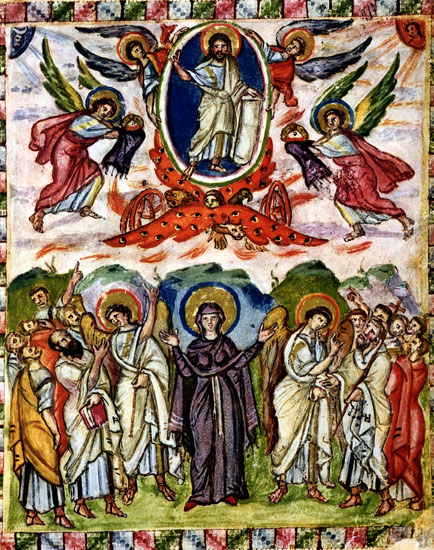
The event that we celebrate on this feast,
the Ascension of Jesus into heaven,
is recounted in our first reading, from the book of Acts.
Our Gospel reading, from Matthew,
doesn’t mention the Ascension
but rather tells us of the risen Jesus
commissioning his disciples
and promising to remain with them always.
Even though Matthew’s Gospel does not recount
the event of the Ascension,
there is a deep connection between this story
of the commissioning of the disciples
and Jesus' ascending to the right hand of the Father.

Matthew tells us that when the disciples saw Jesus,
“they worshipped, but they doubted.”
What is it that they doubt?
They don’t seem to doubt Christ,
since it says they worshipped him.
Perhaps they doubt their own capacity
to carry out the mission Jesus is giving them.
It is, after all, a daunting task he gives them:
“make disciple of all nation. . .
teaching them to observe
all that I have commanded you.”
Not, “make disciples of some nations”
or “make disciples of as many nations as you can,”
but “make disciples of all nations.”
Not, “teaching them to observe
some of the things I have commanded you”
or “teaching them to be just a little bit better,”
but “teaching them to observe
all that I have commanded you.”
This is a pretty tall order.
No wonder they doubted.
How is it possible for their small band
to make disciples of all nations?
How could they even remember,
much less teach others to observe,
all that Jesus had commanded them?
Perhaps it was these two “all”s
that caused them to doubt.

But the commission
to make disciples of all nations
and to teach them to observe
all that Jesus had commanded
is matched by two other “all”s in Jesus’ words:
“All power in heaven and on earth has been given to me”
and “I am with you always,” –
the Greek is literally “all the days” –
“until the end of the age.”
As if in answer to the disciples’ doubts
about their ability to go to all the nation
and to teach them all that Jesus had commanded,
Jesus reassures him that he has “all power”
and will be with them “all the days”
and that they should therefore
not doubt their ability to carry out
the mission that he is giving them.

And it is in this second pair of “all”s that we find
the true meaning of this feast of the Ascension.
 
As St. Paul says in our second reading,
the Father of glory has raised Christ,
“far above every principality,
authority,
power
and dominion”
and has “put all things under his feet”
so that now he “fills all things in every way.”
If we think of this feast simply as saying
that Jesus has gone to live with God
somewhere above the clouds,
then it might seem as if the Ascension
places Jesus at a greater distance from his disciples
and calls into question his claim
that he will be with them all the days,
until the end of time itself.
But if we think of the Ascension
as Jesus’ full sharing in divine power
then, rather than being a departure,
it is what Pope Benedict has called
“the beginning of a new nearness.”
Jesus in his humanity is now present
to all times and places
just as God is present always and everywhere.
The Ascension tells us that the one who was born of Mary,
taught and healed,
suffered and died,
is as near to us as he was to his disciples
two millennia ago;
indeed, he is in some sense nearer to us.
He is present to us
because he has received power to fill all things.
And if he is with us then we need not doubt
that he will bestow upon us what we need
to fulfill the mission that he gives us.

It is easy for us to fall into thinking that we Christians
are followers of someone who lived a long time ago
and who remains with us only in the form
of some interesting stories and intriguing ideas.
But the feast of the Ascension tells us that this is not true;
when we say that Jesus has ascended to the right hand of God,
we are not saying that he has left this world for some other,
but that he is present in this world
with a new nearness,
sharing with us the power of his risen life.

Where is the ascended Jesus?
Not calling out to us across the centuries,
but speaking to each of us directly
in the words of Scripture.
Where is the ascended Jesus?
Not somewhere above the clouds,
but placing himself in our hands
in the Eucharist we celebrate.
Where is the ascended Jesus?
Not managing some cosmic bureaucracy
but consoling and challenging us
through our fellow Christians
who are his body, the Church.

Like the disciples, we too worship . . .
and doubt.
We come here to worship,
because we believe in him,
but we also doubt that we can do all that he asks of us.
But the feast of the Ascension calls us
to cast those doubts aside
and believe that the one
who “fills all things in every way”
is present to us with a new nearness,
even until the end of time.

Sunday, May 8, 2011

Easter 3


If you will indulge me for a moment of grammatical reflection,
think about the word “hope” in relation to verb tenses.
Hope is normally something we speak of in the present tense,
as when we say, “I hope it won’t rain tomorrow”
or, as in our second reading today, when St. Peter reminds us
that our “faith and hope are in God.”
While hope is always directed to the future,
we normally think about it
as something that is going on in the present.
Hope in the present tense is a hope that we possess –
a living hope.

But our first reading gives us an example
of hope spoken in the future tense,
when Peter quotes Psalm 16, saying,
“my flesh, too, will dwell in hope.”
It seems at first a bit odd to speak of hope
as something we will have in the future,
as if we were to say, “tomorrow I will hope it doesn’t rain.”
Maybe what we have here is something like a hope for hope –
a hope that we do not yet experience, but which we desire.

What about hope spoken in the past tense?
What about when we say, faced with our soggy picnic,
“I had hoped that it wouldn’t rain today”?
Or, perhaps, “I hoped that this job interview would work out,”
or “We were hoping that the tumor was benign,”
or “I hoped we would grow old together.”
In every statement of hope placed in the past tense
we hear echoes of a story
of disappointment
or disillusion,
of broken dreams
and abandoned aspirations.

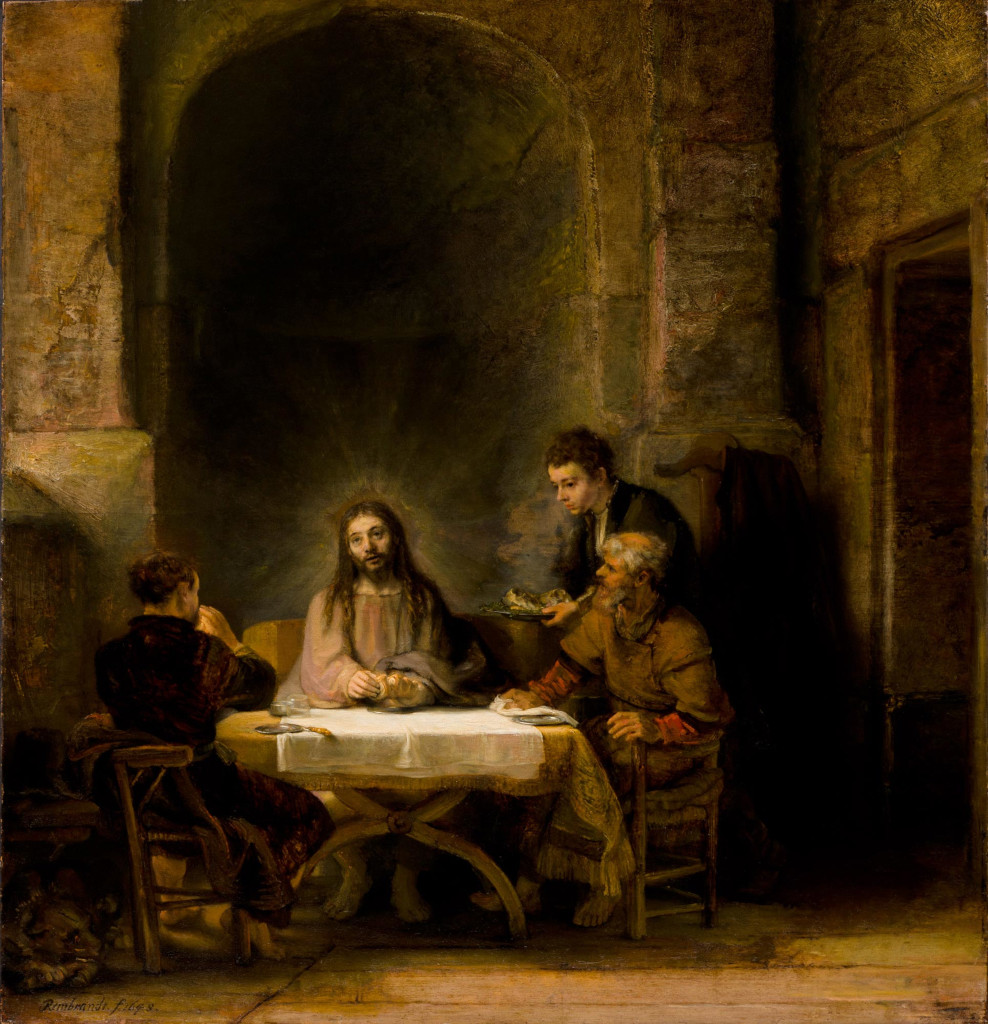
This is what we hear echoing in the words of the disciples
as they converse with the unrecognized Jesus
on the road to Emmaus:
“we were hoping
that he would be the one to redeem Israel.”
These are words full
of the pathos of hope in the past tense:
“we were hoping. . . ,”
with the implied-but-unstated conclusion:
“. . . but now we hope no longer.”
These words sum up the shattering effect of the crucifixion
on Jesus’s followers:
they speak of a heritage of hope
that had been bequeathed to the people of Israel,
a hope for a savior who would free them from oppression;
they speak of the hope that in Jesus
all of God’s promises would be made good;
they speak of the death of that hope on Mount Calvary
and its burial in the garden tomb.
Perhaps only a hope of such comprehensive grandeur –
a hope that everything would be set right –
could come crashing down with such devastating force.
The disciples’ words speak of a hope
that has been so thoroughly snuffed out
that even the reports of the women
about the empty tomb
cannot bring it back to life.
Indeed, in their disappointment,
the very presence of Jesus walking beside them
goes unrecognized.

But, of course, the story does not end there.

We are told how, as they walk along together,
the risen Jesus explains to them
the true meaning of that heritage of hope
that had been so disappointed:
how it was “necessary that the Christ should suffer these things
and enter into glory.”
While this is not enough to reawaken their hope,
to allow them to recognize the risen Jesus,
it moves them just enough to ask this stranger
to stay the night with them.
Perhaps this is a case of hope in the future tense:
his words awaken in them a desire to someday hope again.

And so, as night falls, Jesus sits at table with them,
takes the bread,
says the blessing,
breaks it
and gives it to them.
And then their eyes are opened;
they recognize him in the breaking of the bread;
hope is reawakened in them
and they can see the truth of the risen Jesus;
the hope that was just a memory,
something that seemed irretrievably past,
becomes a present reality
as they receive the bread of life at Christ’s table.

And it can be that way with us, as well.
As we come to recognize Christ at the table of the altar
our hopes that had fallen into the past tense
can be spoken again in the present tense.
We who said, “we were hoping. . . ,”
with the implied-but-unstated conclusion:
“. . . but now we hope no longer,”
can know in the breaking of the bread
the presence of Christ, risen and alive,
just as those disciples at Emmaus did.
And a hope that knows the risen Christ
is a hope that can be spoken in the present tense.

We are surrounded by things
that seem to offer us hope:
medical breakthroughs
that promise cures deadly diseases,
forecasts of economic revival
that could fulfill out material wants,
and even the killing of a particularly evil man,
whose death might promise
an end to violence and terror.
But all of these hopes
can so easily slip into the past tense.
For all of our medical breakthroughs,
we still die.
Every economic revival
is followed by a downturn,
and our material wants remain insatiable.
The killing of one evil man
typically generates two or three more,
ready to take up his mission of violence and terror.
And we find ourselves saying, “We were hoping. . .”

But as Christians we believe
that the hope that we receive at this altar –
a hope that is born in the breaking of the bread,
a hope that is raised up with the risen Jesus –
is a hope that is always spoken in the present tense.
Christ is risen,
giving us a hope that will never die again.
So let us leave behind all illusory hopes,
which so quickly slip into the past tense,
and cling to the one hope
that rises with Christ and lives forever.

Thursday, April 21, 2011

Holy Thursday


“Jesus loved his own in the world
and he loved them to the end.”
So John begins his account of the last supper,
which presents us with the striking scene
of Jesus washing his disciples’ feet.

“He loved them to the end.”
Not simply the “end” in a chronological sense –
the point at which something ceases –
but the end in the sense of a goal that has been reached,
a process that has been completed,
a task that has been finished.
Knowing that his hour has come
in which he is to pass from this world to the Father,
Jesus does the work God has given to him,
a work that can only be fulfilled by love,
a work whose completion he will announce on the cross
when he declares, “It is finished.”

The washing by Jesus of his disciples’ feet
is not simply an example of service;
it is an enacted parable of his whole life.
The water that he pours over his disciples’ feet
is the living water that he offered
to the Samaritan woman at the well;
it is the water that will flow forth with blood
when his side is pierced on the cross;
it is Jesus himself,
pouring out his life for his disciples out of love,
for it is through such love that he accomplishes the task
that his Father has given him to do.
Only when he has poured out his life
for the life of the world
can he say “it is finished;
I have loved them to the end.”

It is finished,
but it is still going on:
Jesus continues to wash our feet today,
as he pours out his life for us
through the living water of baptism
and in the Eucharistic feast of his body and blood.
Jesus still washes our feet
because he gives himself totally
for each and every one of us,
holding nothing back.

And this is what he commands us to do as well:
“I have given you a model to follow,
so that as I have done for you, you should also do.”
Our participation in the ritual of washing feet
is an enacted parable of our own willingness
to give ourselves totally
for each and every one of our brothers and sisters,
holding nothing back.

But there’s the difficulty.
We see in Jesus the completion of love’s task
but we also see in ourselves love’s failures.
As every person knows,
no matter how fully we seek to love
there seem always to be those moments when,
even with the ones we love most deeply,
we say, “I can’t tolerate another moment.
I can’t forgive that hurt.
I can’t love that far.”
We see in ourselves the pride,
the grudges,
the prejudice,
the lack of patience –
all of the things that stand in the way
of giving ourselves totally in love,
the the things that keep us from saying
“it is finished;
I have loved them to the end.”
We know that as much as we try to reach that goal,
we always seem to stumble.

And this is why we cannot simply wash feet,
but must also let our feet be washed.
Our only chance of loving as Christ loved,
of pouring out our lives
and holding nothing back,
is to let ourselves be loved by him:
to let him bathe our stumbling feet
with his own mercy.

On the night before he died,
Jesus gathered with friends and betrayers,
some of whom were one and the same people.
He knew the failures of love.
He saw it in Judas.
He saw it in Peter.
He sees it in us.
He knows that the feet he washes
are feet that will stumble,
yet he washes them anyway,
to bathe us in his own life poured out.
And bathed in his life we, in our own imperfect way,
can join him in love’s task,
called forward into another day’s living by his great cry of victory,
“It is finished;
I have loved them to the end.”

Sunday, April 3, 2011

Lent 4


Confronted with a man who was born blind,
Jesus’ disciples ask,
“who sinned, this man or his parents?”
A devastating earthquake hits the island of Haiti
and American televangelist (and sometime politician) Pat Robertson
asks whether this might be because of a pact
the Haitians had made centuries ago with the devil.
Who sinned, the Haitians or their parents?
An even stronger earthquake
and the resultant tsunami
pushes Japan to the brink of a nuclear crisis
and the governor of Tokyo asks
whether this might not be divine punishment.
Who sinned, the Japanese or their parents?

We might think that faced with such misery
we would never raise such questions
but it is a natural human response to misfortune
to ask why such things happen,
to ask who is to blame,
to seek some past action on someone’s part
that would justify the pain and suffering
that has occurred.
We desire to find order in the world;
for if we can figure out how misfortune and disaster
are connected to someone’s past action
then the perplexity that accompanies such events
might be dissipated,
and we can restore our belief
that the world really is, despite all appearances,
a reasonable, just and orderly place.

But Jesus approaches the misery and misfortune
of the man born blind
in a different way:
in response to his disciples’ question
he says that, “Neither he nor his parents sinned;
it is so that the works of God
might be made visible through him.”
Jesus then spits on the ground, makes a muddy paste
and, rubbing it in the man’s eyes,
heals him and restores his sight.

I don’t think Jesus is saying
that God blinded this man from birth
just so that Jesus could come along, decades later,
and heal him.
Rather, he is indicating to his disciples that,
when confronted with human suffering,
they are asking the wrong sort of question.
They are seeking an explanation
of where misfortune comes from:
Why was this man born blind?
Why must the suffering of the poverty-stricken people of Haiti
be magnified by a terrible earthquake?
What did the people of Japan do
to deserve a catastrophic tsunami?
But these sorts of questions are unanswerable,
or at least whatever answers God has to them
are probably not the kind of thing
we mere mortals might understand.
Instead, Jesus redirects the attention of his disciples
from asking about the reason for suffering
to the ministry of alleviating suffering.
The source of the misery and misfortune of the man born blind
remains hidden.
What is visible is the healing, saving, enlightening power of Jesus.
What is visible is the ministry of Jesus, the light of the world.
Into the darkness of the man born blind, Jesus brings his light
both to heal the man’s physical blindness
and to give to him the eyes of faith,
so that he might recognize the power of God
in the one who has healed him.

Having been enlightened by Jesus,
the man becomes himself a source of light,
bearing witness to Jesus
before those who would oppose him.
This remarkable transformation from darkness to light
is echoed in our second reading,
from Paul’s letter to the Ephesians:
“Brothers and sisters:
You were once darkness,
but now you are light in the Lord.”
Notice that Paul says to the Ephesians
not simply that they have received light in their darkness,
but that they have become light.
The light that they have received
they are now to share with others.

In other words,
now that they have received Christ’s light
they are called to share in Jesus’ ministry
of healing, saving, and enlightening.
Notice that in today’s Gospel Jesus says to his disciples,
“We have to do the works of the one who sent me while it is day.”
Not I, but we –
the disciples are called to share
in Jesus’ ministry of light in darkness.

Faced with human misery and misfortune,
whether that of the man born blind
or the disasters of our own day,
true followers of Christ
must not let the inevitable questions about “why”
keep them from answering Jesus’ call
to join in his ministry of light:
“Awake, O sleeper,
and arise from the dead,
and Christ will give you light.”
Through the light of Christ,
we become light.
And, transformed into light,
we can respond to the call
that he gave to the disciples
who witnessed his transfigured glory:
“Rise, and do not be afraid.”
Rise, and join me in being light
in the darkest places of human misery and misfortune.

Sunday, March 6, 2011

9th Sunday in Ordinary Time


On this last Sunday before we enter the season of Lent
our Gospel reading offers us the conclusion
of Jesus’ Sermon on the Mount,
which we have been hearing for the past five Sundays.
Jesus has been laying down for us
the challenge of being his disciple:
the challenge to be poor in Spirit,
to be salt of the earth,
to turn the other cheek,
to love our enemies,
to not worry about tomorrow,
to seek first the kingdom of God.
This is the challenge that we take with us
into the Lenten season,
as we prepare to celebrate the great mystery
of the salvation that comes to us
through Jesus’ suffering, death and resurrection.

That’s a pretty long to-do list.
You had better get busy.

But in today’s Gospel,
Jesus concludes the Sermon on the Mount with a warning.
He speaks of those who are very busy with their to-do lists –
saying, “Lord, Lord,”
prophesying in Jesus’ name,
driving out demons in Jesus’ name,
doing mighty deeds in Jesus’ name –
and he tells us that he will say to them, “I never knew you.”
He never knew them
because they were too busy with their to-do lists
to stop and to listen and to come to know him.
He contrasts them with the person,
“who listens to these words of mine and acts on them.”
The problem is not that they are busy with their to-do lists,
but that they have assembled those lists
without first listening to the words of Jesus.
They have not listened to him
so that they might come to know him
and to know what it is that he is asking of them.

Notice the kinds of things that are on their to-do lists:
prophesying,
driving out demons,
doing mighty deeds –
big, flashy things that might make you
the first-century equivalent of a celebrity,
with a million people following you on Twitter.
Compare this with the picture of the disciple
that Jesus has sketched for us
in the Sermon on the Mount:
poor in spirit,
merciful,
peacemaking,
and even insulted and persecuted.
Not the sort of person
who is likely to be tweeting their latest mighty deed
done in the name of Jesus.

So maybe the first challenge of Lent
is not one of working our way
through our to-do list of mighty deeds,
but simply of listening to the words of Jesus
as these come to us through the scriptures
and in our prayerful reflection.
For if we act before we listen,
our to-do list is more likely to represent our agenda than Jesus’;
it will end up being a lot more about glorifying ourselves
than about glorifying God,
even if we drape our deeds
in the fig-leaf of piety,
saying “Lord, Lord.”

Jesus goes on to say in today’s gospel, however,
that listening is not enough.
If we want our house to be built on solid rock
rather than on shifting sand
we must not only listen to his words,
but also act on them.
We must not act without first listening,
but we also must not listen without then acting.
The demanding picture of the disciple that Jesus’ gives us
in the Sermon on the Mount
is not simply an ideal that we are to admire
but a concrete set of instructions
that we are to embody in our lives.
We will, of course, fail.
We will be prideful
rather than poor in spirit.
We will hold grudges
rather than be merciful.
We will try to defeat our opponents
rather than be peacemakers.
We will surrender our ideals
rather than face insults and persecution.
As Paul reminds us in our second reading,
“there is no distinction;
all have sinned and are deprived of the glory of God.”
But he also goes on to say that we are justified –
put back on the right path –
by God grace, “through the redemption in Christ Jesus.”

I suspect that your Lent, like mine,
will end up being something of a disappointment.
Prior experience tells me
that I will try to act without first listening,
or I will listen, but never get around to acting,
or, perhaps most likely,
I will fail to do either much listening or much acting.
But if we can manage to listen even just a little
to the words Christ will speak to us over these next six weeks
we will hear of his power and his glory
that is revealed in suffering and weakness.
We will hear of “the righteousness of God
that comes through faith in Jesus Christ”
and we can hope for some share in his righteousness,
not because we have said “Lord, Lord,”
or because we have done mighty deeds in his name,
but because we have listened and acted on our faith –
our faith in the mighty deed of God in Jesus Christ
by which we have been saved.
This Lent, let us make listening to Jesus and acting on his word
the solid rock on which we build.

Sunday, February 6, 2011

5th Sunday in Ordinary Time


Salt has been on my mind this week.
Not only has it been all over our streets,
melting ice and messing up our cars,
and not only do the new dietary guidelines
released by the federal government
say that we Americans,
in addition to consuming too much fat and sugar,
consume too much salt,
but it is also a central image
in this week’s Gospel reading.

Jesus tells his followers
that they are “the salt of the earth,”
evoking a whole web of associations
that human beings have with salt.
Salt is almost certainly the oldest seasoning
used by the human race:
we have archeological evidence of facilities
for the refining of salt
as early as 6000 BC.
Of course, salt was used for more
than making Neolithic french-fries tastier:
salting was for many centuries
the only way we had to preserve food from decay and corruption.
Salt was, in fact, so valuable
that a wide variety of cultures have used it for religious purposes:
in ancient Egypt, Greece and Rome
salt mixed with water was offered to the gods;
in ancient Israel,
salt was included in grain offerings and burnt offerings;
salt was used to purify and to exorcise,
but it also symbolized the table fellowship of a shared meal.

So when Jesus tells his followers
that they are the salt of the earth,
he is, as is the case with any good metaphor,
saying a number of things at the same time.
True disciples give our world its savor;
they are the element preserving the world
from decay and corruption;
they are an offering to God;
they are a foretaste of the day
when humanity will be gathered around the table
in God’s kingdom.

But, having told them that they are salt,
Jesus also warns them:
“if salt loses its taste, with what can it be seasoned?
It is no longer good for anything
but to be thrown out and trampled underfoot.”
If the disciples of Jesus lose their power to season and preserve
then they are useless,
they have no purpose,
and, like salt with no flavor, they will be cast aside.

We ought to be careful here, however.
We cannot simply assume that because we see someone
cast out and trampled underfoot
that he or she is salt that has lost its taste
and become worthless.
Remember that Jesus is saying this
immediately after telling his disciples
“Blessed are they who are persecuted
for the sake of righteousness,
for theirs is the kingdom of heaven.”
For Jesus, it is precisely those who,
in the eyes of the world,
have been cast out and trampled underfoot,
who are the true salt of the earth,
who give life its savor,
who preserve the world from decay and corruption.

In our second reading, Paul tells the Corinthians,
“I came to you in weakness and fear and much trembling,”
not bringing with him words of human wisdom
but only his faith in Christ crucified,
Christ outcast ,
Christ trampled underfoot.
And it is only in this way
that we can proclaim the Gospel of grace.

This completely turns the logic of the world upside down.
Those whom the world might think of as failures,
who are willing to be persecuted for the sake of righteousness,
are the true salt of the earth
and possessors of the kingdom of heaven.

Earlier this week I saw a remarkable photograph
taken in Cairo’s Tahrir Square,
where anti-government demonstrations in Egypt
have been centered.
A large number of Muslim demonstrators kneel in the square,
performing the prayer that Muslims make five times a day.
They are encircled by a protective perimeter
formed by Coptic Christians
who stand with hands joined to ensure
that their fellow protesters
are not disturbed or attacked as they pray.
These Coptic Christians are a minority in Egypt,
and at times have been persecuted by their fellow Egyptians,
perhaps even by some of the very people they are now protecting.
But, by their actions,
they show themselves willing to look beyond that history
because they recognize the cause of righteousness
and are willing to risk, quite literally,
being cast out and trampled underfoot.

It is by actions such as this that the disciples of Jesus
show themselves to be the salt of the earth,
a light that gives light to all the world.
It is those who fear and flee
the persecution that often accompanies discipleship
who are the salt that has lost its flavor
and must be cast aside.
Saint Augustine wrote that
we should not fear being trampled underfoot in this world
as long as our spirit is rooted in heaven
(The Lord’s Sermon on the Mount 1.6);
For it is our being rooted in God
that allows us to live as Jesus’ disciples,
to embrace the risk of being persecuted for righteousness sake,
and to be the salt that flavors and preserves the world.

Sunday, January 9, 2011

Baptism of the Lord


There are two days in the Church year
when the sacrament of Baptism is brought into sharp focus.
One is Easter.
As most of you know,
it is the practice of the Church to baptize adults at Easter,
during the Easter Vigil, which is the high point of the Church year.
Here, we see Baptism in the context of our celebration
of the dying and rising of Christ,
as the sacrament in which we die with Christ to sin
and are raised with him to new life,
making us members of his body, the Church.
This is a way of thinking about Baptism that will, I hope,
seem familiar to many:
Baptism cleanses us of original sin
and makes us part of the Christian community.
We might call this the “Easter meaning” of Baptism.

The other day on which Baptism is brought into sharp focus is today,
the feast of the Baptism of the Lord.
Here the focus is not on the dying and rising of Christ,
but on Jesus’ own baptism,
which is recounted by Matthew in today’s Gospel reading.
This feast, no less than Easter,
ought to shape our thinking about Baptism,
because it fills out the meaning of Baptism
and gives us a fuller understanding of our own Baptisms.

While the Easter meaning of Baptism
looks to the conclusion of Jesus’ earthly ministry,
today’s feast points us to the beginning of Jesus’ ministry
and to his baptism as the inauguration of his public life
as the servant and witness to God’s kingdom.
Having spent some thirty years
living what our tradition calls the “hidden life” in Nazareth,
Jesus comes to John to be baptized.
Coming up from the water, the Spirit of God descends upon him
and the voice of the Father speaks:
“This is my beloved Son, with whom I am well pleased.”
Jesus is publicly identified
as the one spoken of in our reading from Isaiah:
“Here is my servant whom I uphold,
my chosen one with whom I am pleased,
upon whom I have put my spirit.”
Thus begins Jesus’ public ministry as God’s anointed one.
As our second reading, from the Book of Acts, puts it:
“God anointed Jesus of Nazareth with the Holy Spirit and power.
He went about doing good
and healing all those oppressed by the devil,
for God was with him.”

If we think of Baptism in this context,
we can see that our Baptism, no less than Jesus’,
ought to be the inauguration of a life of service and witness.
In Baptism, we are not simply washed of original sin
and made part of the Church,
but we are given a job to do,
a way of life that we are to live.
In Baptism, we too become God’s beloved sons and daughters,
and we are given the task of ministering in Christ’s name.

And what it means to minister in Christ’s name
is to let Jesus’ manner of service and witness
become the pattern for our own service and witness.
Our reading from Isaiah in many ways sums up Jesus’ ministry:
“he shall bring forth justice to the nations,
not crying out, not shouting,
not making his voice heard in the street.
a bruised reed he shall not break,
and a smoldering wick he shall not quench,
until he establishes justice on the earth.”
When we think of Jesus’ ministry in light of this passage from Isaiah,
what stands out is his gentleness, his patience,
his willingness to bear with the weak and faltering
and his unwillingness to use force as a way of establishing justice.
This is the ministry and witness to which we are called in our Baptism:
a way of life characterized by the same sort of
gentleness,
patience
and compassion
that Jesus showed.

Of course, we must not forget
that it was this path of
gentleness,
patience
and compassion
that led Jesus to his cross.
We ought not to mistake the gentleness of Jesus for weakness
nor his patience for inaction.
Indeed, the service and witness of his compassion
was so threatening to the religious and political leaders of his day
that he had to be eliminated, being nailed to a Roman cross.
And we have no reason to believe that the ways of the world
have changed all that much since Jesus’ day,
and if we follow faithfully the path of Jesus
we should not be surprised
if we too face opposition,
if we too must carry the cross.

And it this way, the meaning of Baptism
that we draw from today’s feast
is linked to the Easter meaning of Baptism,
because it is the ministry that is entrusted to Jesus at his baptism
that will lead him to the suffering of the cross
and the glory of resurrection.
And for us too, faithful to the way of Jesus
and trusting in God grace,
our Baptism initiates us into the ministry of Jesus
even as it makes us sharers in the mystery
of his cross and resurrection.
For many of us, our Baptisms may have been a long time ago,
but it is never to late to recommit ourselves to the way of Jesus,
the way of gentleness,
patience
and compassion.

Sunday, December 26, 2010

Holy Family


Today, on the Feast of the Holy Family,
we continue to celebrate the mystery of the Incarnation –
our belief that God the eternal Son,
through whom all things were made,
became flesh and dwelt among us, full of grace and truth;
in Jesus Christ God has lived a human life.
But more than that, today’s Gospel reminds us that
in Jesus Christ God has chosen
to live a certain kind of human life.

This morning St. Matthew presents us
with what is still in our world
an all-too-familiar human story:
a family fleeing violence in their homeland
undertakes a journey involving great peril
to seek refuge in a foreign land
where they may not speak the language,
where their religion and culture and ethnicity
may appear to their neighbors to be alien
and perhaps even threatening,
where whatever social or economic status
they had in their homeland
may not translate into similar status in their new home,
where they may find themselves living on the margins of society
without any way to move into the mainstream.
Jesus, Mary and Joseph find themselves
among the ranks of history’s refugees,
among the “displaced persons”
who throughout history have had to choose
between violence at home and exile in a foreign land.

There are many other all-too-familiar human stories
involving families:
families locked into cycles of poverty and social marginalization,
families torn apart by broken promises and old hurts,
families that are scenes of physical and emotional violence
rather than havens of peace.
These all-too-familiar human stories remind us
that all of us are in some sense “displaced persons”
who live our lives exiled from all that we had hoped
those lives might have been.

The mystery of the Incarnation is that God,
the creator of heaven and earth,
of all things visible and invisible,
has chosen to live among us
and to make this all-too-familiar human story his own.
God, who is supremely rich,
the source and center of the world’s existence,
chose to be poor,
exiled,
threatened,
marginal,
defenseless,
betrayed,
abused
and ultimately to die on the cross.
Without ceasing to be God,
the Word becomes flesh and dwells among us,
sharing the joys and hopes,
the sorrows and anxieties,
of the human race.
As Saint Catherine of Siena put it:
“You, God, have clothed yourself in our humanity,
and nearer than that you could not have come” (Dialogue ch. 153).

God becomes human, sharing our human poverty,
so that we humans might come to share in God’s riches.
God becomes a displaced person,
so that we might find in God the place where we truly belong.
The mystery of the Incarnation is just this simple
and just this mysterious:
God has joined us in our exile
to transform that place of exile into our true home,
to make us members of God’s holy family.

And if this is true, then we ought to live with each other
in a way that reflects this mystery.
The letter to the Colossians tells us:
“Put on, as God’s chosen ones, holy and beloved,
heartfelt compassion, kindness, humility, gentleness, and patience,
bearing with one another and forgiving one another.”
This too is something supremely simple . . . and mysterious.

It is something simple because this way of living
has been shown to us by Jesus –
in the face of the all-too-familiar human story
of betrayal and disappointment,
he chose to live a life of openness and compassion;
in him we have been shown what a truly human life looks like,
we see what it means to find our place in God’s family,
to be sons and daughters of God.
How we ought to live together is as simple as the story of Jesus.

But it is also something mysterious,
because we know
that we can live this truly human life,
that our place of exile can become our true home,
that we can find our place in God’s family,
only if we open ourselves to God’s grace.
We can be compassionate,
kind,
humble,
gentle,
patient,
forgiving
only if we, as the letter to the Colossians says,
let the word of Christ dwell in us richly –
if we, like Mary and Joseph, have Jesus with us in our land of exile.
As Paul reminds us,
“whatever you do, in word or in deed,
do everything in the name of the Lord Jesus,
giving thanks to God the Father through him.”

In the Incarnation, God did not simply live a human life,
but God lived the all-too-familiar human story
of exile and rejection.
And the joy of Christmas is that in living that story
Jesus has rewritten it,
Jesus has transformed it,
Jesus has triumphed over it
and so has made this our land of exile
into the place where God dwells richly among us,
making us into the holy family of God.

Sunday, December 12, 2010

Advent 3


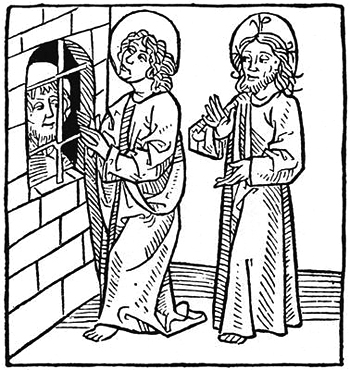
“Are you the one who is to come,
or should we look for another?”
This is the question that John the Baptist,
imprisoned by King Herod and facing execution,
sends his followers to ask Jesus.
“Are you the one who is to come,
or should we look for another?”

This question is a puzzling one.
Why would John, whom we heard last week
confidently heralding Jesus’ coming,
suddenly seem to doubt that Jesus really is God’s anointed one?
Having proclaimed him the one who is to come,
why would he be sending his followers
to ask if Jesus is really the one who is to come?
Has he forgotten?
Does he think he might have been wrong?

Early Christian theologians were puzzled by this as well,
and tended to think that John
was not really asking a genuine question,
but was posing the question rhetorically,
for the benefit of his followers.
In other words, he knows the answer,
but he wants his followers to hear the words
from Jesus’ own lips
so that they will know, as John knows,
that Jesus is the one who is to come.

I have always found this interpretation of John’s question
somewhat dissatisfying,
probably because I find disingenuous rhetorical questions
somewhat irritating,
as if John were trying to be sly,
by pretending not to know something that he knows perfectly well.

Pope Gregory the Great, in the late-6th century,
took a different approach to this story.
As he interprets it, John is asking a genuine question.
He has no doubt that Jesus is the promised Messiah,
since he had clearly declared this at the beginning of the Gospel,
when he served as Christ’s herald.
But now, at this point in the story,
John is seeking to know something different.
John is facing execution at the hands of Herod;
he knows that he will soon depart this life
for the realm of the dead.
Thus, Gregory says, he is asking
whether he will also be Christ’s herald among the dead,
whether Christ, who had come into our world as God with us,
would also be God with us even in death.
As Gregory puts it, it was as if John were asking,
“Just as you deigned to be born on behalf of human beings . . . ,
will you also die on our behalf” (Homily 5).

I will admit,
Gregory’s interpretation might seem like just as much of a stretch
as the interpretation that says
that John is asking only a rhetorical question.
Yet there is something about it that makes sense to me.
Facing death, John is confronted with a new question:
how deep does your faith in Jesus go?
He believed fervently that Jesus had come into this world
to share our human life.
Now John wants to know,
has he come also to share our human death?
In our Gospel last week John had declared,
“the one who is coming is mightier than I.”
Now John asks, “just how mighty are you?
Are you mighty enough to conquer even death?
I am about to go into the darkness.
Will you be there?
Are you mighty enough to follow me into that dark place
and bring me back to the kingdom of life?”
Will you be there to say to me,
“Be strong, fear not!
Here is your God, he comes with vindication;
with divine recompense he comes to save you.”
John is asking for the gift of faith, to believe that,
even into the mystery of death,
Jesus is the one who is to come.
He will come with his light to dispel death’s darkness.

And as with John, so too with us:
we too ask of Jesus,
“Are you the one who is to come, or should we look for another?”
Are you the one who will come to me
in the darkest places of my life?
Will you be there when I am in pain,
when I am alone,
when I am terrified,
when I am confused,
when I am in the valley of the shadow of death?
Are you the one?
Are you mighty enough to share my weakness?
You who deigned to be born on behalf of human beings,
will you also die on our behalf?
Joining me in death, will you lead me back to life?

We pray in this Advent that God would find us ready,
expectant,
waiting to receive Jesus.
But perhaps even more we should pray
for a deeper faith that it is Jesus who is ready,
expectant,
waiting to receive us.
Let us pray this Advent
that God would find us ready to believe
that no place is so dark that God in Christ is not there,
ready to meet us with joy and gladness,
ready to set sorrow and mourning to flight.

Sunday, November 7, 2010

32nd Sunday in Ordinary Time


“You can’t take it with you.”
That is at least part of Jesus’ reply
to the Sadducees in today’s Gospel.
The Sadducees were a group within Judaism
who held to a very traditional interpretation of the Law
and who, in particular, rejected what they considered the novel idea
that in God’s kingdom those righteous one’s who had died
would be raised to new life.
We see this belief testified to in our first reading,
from the book of Maccabees:
“the King of the world will raise us up again to live forever.”
For the Sadducees, this idea was a dangerous innovation
that undermined their more traditional view
that people were rewarded or punished by God in this life.
So they pose to Jesus,
who teaches this dangerously innovative idea of resurrection,
the following puzzle:
If a woman’s husband dies, and she marries his brother,
who in turn dies, and she marries another brother,
and so on and so forth through seven brothers
(if I were the seventh brother
I would think twice before marrying this woman),
when the dead are raised to new life,
whose wife will she be?

Jesus’ answer to the Sadducees is twofold.

The first part of his answer is to make clear
that the kind of life led by those
whom God will raise from death to new life
is something quite different from the sort of life we live now.
Those who live in the kingdom of God
“neither marry nor are given in marriage.”
No doubt in God’s kingdom we will still love
those whom we have loved in the time of this life,
but the institution of marriage itself,
tied up as it is with creating households and raising children,
is for this world, not for the kingdom.
People say, “you can’t take it with you,”
and it would seem that, according to Jesus,
marriage is one of those things you can’t take with you.

The second part of Jesus answer to the Sadducees
is that we believe that the dead shall be raised
because we believe that our God is the God of the living;
what it means truly to live is to live in relationship with God
and God’s relationship to those whom God loves
cannot be defeated, even by death.
As Paul says in our second reading,
“the Lord is faithful;
he will strengthen you and guard you.”
Those whom we think of as dead are not dead to God,
and when God’s kingdom is manifested in its fullness
we shall see and know the fullness of life
that is enjoyed by those righteous ones
who have died in God’s cause.
While the saying “you can’t take it with you”
applies to many things in this world,
it doesn’t apply to our relationship with God.
In fact, it seems that this relationship
is the one thing you can take with you.

So Jesus’ response to the Sadducees is to remind them
that the things we think of as making up the fabric of our life –
institutions like marriage,
political structures,
economic systems,
and even the outward forms of the Church –
are in fact simply temporary bulwarks
that we construct against the terrifying reality of death,
and in the age to come they will give way
before the one reality that is the true fabric of our life:
God’s love for us.
You can’t take these things with you
because you don’t need to take them with you;
in the fullness of God’s kingdom,
God’s love alone will unite us with God and with each other
and we will not need those temporary structures
that form the fabric of our lives in this world.

But, of course, we do not yet live
in the fullness of God’s kingdom.
In the time of this life
people still marry and are given in marriage,
they vote and run in elections,
they invest and spend money,
they gather weekly as Church
to hear God’s Word spoken in human words
and to encounter God through sacramental signs.
In the time of this life these things,
provisional though they be,
are the warp and woof from which our lives are woven.
In the time of this life these things,
provisional though they be,
are of crucial importance
to the life that we hope to live in the kingdom of God.
In the time of this life these things,
provisional though they be,
are the means by which we bear witness in this age
to the life we hope to live in the age to come.

Though there will be no marriage in the kingdom of God,
how we live our committed relationships in this age
can become a sign
of how we will live our risen life in the age to come
if we live those commitments
with integrity and honesty and self-sacrifice.
Though there will be, thank God,
no politics or economies in the kingdom of God,
how we inhabit the political and economic structures of this age
can become a sign of our dwelling in God’s kingdom
if we inhabit those structures in such a way that we always look,
not to our own concerns and well-being,
but to the concerns and well-being
of the poor, the outcast and the defenseless.
Though there will be no need
for sacramental signs in the kingdom of God,
how we gather as Church in this age
can become a sign of the heavenly liturgy
that we will celebrate in the kingdom
if we give ourselves generously and without reservation
to the worship of God.

Marriage, power, money,
even the outward structures of the Church. . .
you can’t take them with you
into the risen life of God’s kingdom.
We can, however, use them in this age,
in the time of this life,
as a means by which we begin to live that risen life now.
They are the strands from which
the fabric of our lives is woven,
the lives that we are called to place
at the service of God and neighbor.

Next week we will be asking you to consider again
your financial support of our parish.
I always tell people that if they do not give more money
our doors will not close,
our current staff will not have to be let go;
we will find a way to make do.
But that is not why we give.
We given because even though
both our money and our parish community
are simply provisional realities,
neither of which will go with us into God’s kingdom,
the two of them together
can become a sign of that kingdom here and now.
You can’t take it with you,
but you can use it now in such a way
that it becomes a sign
of the risen life we will lead in the age to come.