Saturday, September 24, 2022

26th Sunday in Ordinary Time


Luke’s Gospel contains many 
of Jesus’ most memorable parables:
the unjust steward and the rich man,
the prodigal son and his sullen older brother,
the man fallen among thieves 
and the Samaritan who helps him.
But today’s Gospel reading is the only parable
in which a character is given a name: Lazarus.
Why might this be the case?

The name “Lazarus” is Aramaic, 
which was the language spoken by Jesus,
and is a form of the Hebrew name Eleazar,
which means “God saves.”
So it is certainly a fitting name for the poor man
who receives from God a heavenly reward.
But Jesus could also have given symbolic names
to other characters in his parables.
The shepherd who goes seeking the lost sheep
could have been named Adriel,
which means “flock of God,”
or the prodigal son’s older brother
could have been named Mara,
which means “bitter.”
But Jesus chooses not to give them names,
perhaps so that we would be more inclined to see them 
as representative kinds or types of people
with whom we might more easily identify.

Yet Lazarus is named.
Perhaps more significant 
than the meaning of his name 
is the simple fact that he has a name at all.
For to have a name is to have an identity
that is more than simply being
a kind or type of person.
To have a particular name is to be unique
and not reducible to an identity category 
like “shepherd” or “older brother.”
To be an individual person and not simply a type
is to be recognized as capable of acting in ways
that are not “typical” or “predicable”
but are surprising and free and often delightful.
To have a name is to become irreplaceable.

This is important in the parable
because the rich man’s sin 
is that he fails to see Lazarus as anything more
than one more poor person he steps over
on his way to another sumptuous meal 
in his purple garments and fine linen.
Though he seems to know Lazarus’s name,
this does not lead him to see Lazarus 
as an irreplaceable individual,
but simply as one more poor person
who is no concern of his,
unless it is to be his servant.

The funny thing is,
by his actions the rich man shows himself
to be nothing more than one more rich person,
behaving in typical rich-person ways:
stepping over the poor as he proceeds
to indulge his appetites and satisfy his desires.
It is the rich man who is locked into actions 
that are typical and predictable,
who has reduced himself to a mere category type
and, in a sense, made himself replaceable,
since there are many of the same type
who are ready to step into his shoes 
and act in the same way.
And when both he and Lazarus die,
and Lazarus is in the bosom of Abraham
and the rich man is in the fires of hell,
the rich man seems unable
to break out of that category type.
Even as he begs for mercy he still presumes
that the poor man should act as his servant,
bringing him water to slake his thirst 
and taking messages to his brothers.
His punishment is unrelenting
because he cannot cease acting in the way
that led him to his sad destiny.

In the Christian tradition, 
the rich man comes to be referred to as Dives,
which might seem like a name,
but is simply the Latin word for “rich.”
His individual identity has been completely lost
and he is nothing more 
than a parody of a human being.
Perhaps this is what hell is:
to cease being an irreplaceable individual 
with a name known by God,
to lose one’s capacity to act in ways 
that are surprising and free and delightful,
to be condemned to following the script
that we once chose for ourselves
but now determines our every action.

Of course, Jesus does not tell this parable
simply to inform us about the afterlife.
He tells it to get us to examine our own lives now.
As Abraham says to the rich man,
we don’t need a miraculous visitation 
from the realm of the dead
to tell us what God thinks of our self-indulgence
and our neglect of the poor.
We, like the rich man and his kind,
have Moses and the prophets,
and the prophet Amos says to us this day,
“Woe to the complacent in Zion!”
Woe to those reclining 
on fancy beds and couches.
Woe to those drinking fine wine 
and getting spa treatments.
Woe to those who see 
the poor one at their gate
as simply a category of human being
that can be dismissed and ignored
as a “panhandler” 
or “welfare queen” 
or “illegal immigrant,”
and not as someone with a name and a story
and an irreplaceable God-given identity,
an identity that we ignore at our peril.

Even more, Jesus is asking us
to look at ourselves and to see
if we have chosen to live our lives in such a way
that we have reduced ourselves to a mere category-type
and lost our capacity to act in ways 
that are surprising and free and delightful.
Do I simply conform to the expectations 
of my social class
or my political ideology
or my generational cohort
or my racial or ethnic identity,
rather than letting God call me by my unique name,
calling me out of any class or ideology or cohort or identity
other than that of “child of God,”
the irreplaceable brother or sister of Jesus
and of all those for whom he died?

Christ is calling us this day
to let ourselves be named by God,
and to learn the names by which he calls
the irreplaceable ones whom we would ignore.
Let this call give us hope that God, 
“the King of kings and Lord of lords,
who alone has immortality, 
who dwells in unapproachable light,”
will, in his boundless mercy.
have mercy on us all.


Saturday, September 17, 2022

A Reflection on the Occasion of the Celebration of Thomas and Courtney's Marriage

Reading: "Inversnaid," by Gerard Manley Hopkins 

Thomas and Courtney, 
as this celebration of your marriage 
has been approaching,
I have been thinking a lot, 
as one does,
about 17th-century philosophers.
Two in particular: 
Baruch Spinoza and Blaise Pascal.

Spinoza and Pascal
lived in a much larger universe than people
who lived just a few generations before them.
The inventions of the telescope and the microscope
revealed a world both much larger and much smaller
than the tidy, earth-centered cosmos
that humanity had lived with 
since time immemorial.
It was dizzying, and kind of threatening,
to be displaced from the center of the universe
into some undetermined place 
between the infinitely large
and the infinitely small.

For Spinoza,
this dizziness could be cured by thinking,
because he believed that 
as far as the universe extended,
thought extended just as far.
At least in principle, 
we could calculate all causes 
and understand the how and why of everything.
He seemingly found peace in this.

Pascal, on the other hand,
believed that thinking could only do so much:
we can think just enough to recognize
how fragile and uncertain our lives are,
how we might be taken out 
by something immensely big, like a class-five rapid,
or by something immensely small, like a virus.
But at the end of the day, this thought
seems only to increase our dizziness
or, as Pascal put it, our wretchedness.

But the limits of thought 
were not the end of the story for Pascal,
because he believed that in addition
to the thinking capacity of reason
we have a capacity that he called “the heart,”
and, as he famously put it,
“the heart has its reasons 
about which reason knows nothing.”

It is the heart that can acknowledge 
reason’s inability to master the universe,
and yet embrace that universe, 
in all of its danger and promise,
with a kind of humility. 
It is the heart that speaks 
in Hopkins’ poem “Inversnaid,”
in which words slip the bounds the reason,
abandon their mission of meaning,
so that our hearts can feel and know and love
the wet and the wildness of the streams
cascading their way down to a highland lake. 
It is the heart that seeks the still point
amid the rushing immensities
of the infinitely large
and the infinitely small,
the still point where we can stand
as we take the infinite into ourselves.

For Christians like Pascal and Hopkins, 
as for me,
that still point is found above all in Jesus,
whom Pascal described as “a God 
whom we approach without pride,
and before whom we humble ourselves
without despair” (Pensées 245).
But, as Hopkins says in another poem,
“Christ plays in ten thousand places,
Lovely in limbs, and lovely in eyes not his
To the Father through the features of men’s faces.”

Thomas and Courtney,
I believe that amid the glorious chaos 
of this infinite world 
your hearts have found the still point
in one another’s faces.
You have found in each other 
that point of equipoise 
that turns the wildness of the world 
from threat into promise,
that point where you can stand 
to take in infinity,
to rejoice in the wet and the wildness,
the weeds and the wilderness.

May the one who plays in ten thousand places 
bless the love you have pledged to each other,
opening your eyes to the miracle of one another,
speaking to your hearts in times of hardship,
and giving you and those you love years of joy.

Saturday, September 10, 2022

24th Sunday in Ordinary Time


We human beings 
have a rather remarkable capacity
for self-deception,
a capacity to willfully overlook truths 
about ourselves and our situation,
truths that by all rights should be quite clear to us.
I think of myself as a kind and generous person,
always willing to help out and volunteer,
while somehow not noticing the way in which
I neglect my spouse and children.
I believe that others have succeeded more than I
because of favoritism and backroom dealings,
when in fact they are just better at their jobs.
I tell myself that I am a social media edgelord
unmasking hypocrisy and subverting paradigms,
when actually I’m just a jerk and a bully
spouting off on Twitter.
Truths about ourselves 
and our place in the world,
are denied and deflected,
often through strenuous effort.
The truth lies before us, 
and we choose not to see it.
We are not the people 
we think ourselves to be.

Self-deception not only pervades our world;
it pervades our Gospel reading today as well.
We see it at work 
in the younger brother,
who desires independence so much
that he drastically misjudges 
his capacity for “adulting,”
as they call it these days,
and seems also to believe 
that his inheritance is limitless,
though a little basic math 
might suggest that it is not.
We see it in the older brother as well,
who is convinced that he is a dutiful son,
showing true love and respect for his father,
when in fact he is seething with resentment, 
not simply toward his brother,
but toward his father as well,
whom he seems to have served out of hope for gain
rather than true devotion and affection.
The truth lies before them, 
and they choose not to see it.
They are not the people 
they think themselves to be.

Self-deception is a funny thing.
It is different from being ignorant or misled.
It is not a lack of information about ourselves,
since the truth about ourselves is readily available
and often perceived, and commented upon, by others.
It is also different from being lied to,
because in self-deception,
we are both the one deceived 
and the deceiver.
We willfully mislead ourselves,
which is quite the trick 
when you think about it,
since it seems to involve
both knowing and not knowing
what it is we are doing,
both seeing and not seeing
the truth we are avoiding.

We deceive ourselves by focusing 
on one truth about ourselves,
and letting the other truths 
that make up the total picture
fade into a kind of blurry background.
I focus on my immediate desires 
and my grandiose dreams
in order to overlook 
my limited skills and resources.
I keep in the front of my mind
years of dutiful service and obedience,
to divert myself 
from the anger and resentment 
that seethe within me.

Self-deception requires us to simplify the world,
to avoid seeing reality in all its complexity,
in order to avoid hard and painful truths.
It might seem like an effective coping strategy,
but it requires an immense outlay 
of psychological effort:
it exhausts us, 
and diminishes us,
and deadens our lives.
Plus, reality has a way of catching up with us.
Like the way that famine in the land 
left the younger brother hungry and penniless,
looking longingly at the food of pigs.
Our Gospel translation says that “he came to his senses”—
the original Greek says literally “he came to himself.”
His eyes were opened to the truth of himself,
the truth of his situation.
He encountered reality,
and reality was merciless in its truth telling
and humbling in its mercilessness.

We deceive ourselves 
because we fear the truth about ourselves.
We fear that if we let reality come into focus
we will not be able to carry on 
in the face of that merciless reality,
that we will see ourselves revealed
as unlovely and unlovable.
But the parable of the prodigal son,
is not simply a story 
of being humbled by merciless reality.
It is the story of the merciful God,
who rejoices that 
we who lay dead in self-deception
have come to life again,
we who were lost in lies
have been found by the truth.

For, in the end, to be found by truth
is not to be subjected to merciless reality;
it is to be found by the God
who came to dwell among us in Christ,
who is the way, the truth, and the life.
The face of reality is the face of Jesus Christ,
and the deepest truth about ourselves 
is that we are children of a loving father,
a father who runs out to embrace us
when our illusions collapse
and we see ourselves as we really are.
The reality of our situation 
is that even as we seethe with anger and resentment
God seeks us out and invites us to join the banquet.
God calls us out of self-deception 
not simply to humble us—
though learning humility is a part of it—
but so that we might come to see,
as the two brothers in the parable 
must come to see,
that we are beloved,
that we are embraced,
that we are invited to the banquet of life
prepared for us from all eternity.
God calls us out of deception and into reality
so that God who is merciful
might have mercy on us all.

Saturday, August 13, 2022

20th Sunday in Ordinary Time


I imagine that many of you 
did not come here today 
expecting to hear Jesus say,
“Do you think that I have come 
to establish peace on the earth?
No, I tell you, but rather division.”
With all of the division in the world right now,
did Jesus really come to make it worse?
Didn’t he come, as Zechariah said,
“to guide our feet into the way of peace”?
Didn’t he tell the disciples he sent forth
to let their first words upon entering a house
be “Peace to this house”?
Weren’t his first words to his disciples 
after his resurrection “Peace be with you”?
This is the Jesus we are used to,
and whose words captivate us.

Jesus’ words of peace captivate us because
they speak to our deepest desires in a divided world.
St. Augustine said, “peace is so great a good
that even in relation to the affairs of earth
and of our mortal state
no word ever falls more gratefully upon the ear,
nothing is desired with greater longing,
in fact, nothing better can be found” (Civ. Dei 19.11).
Everyone desires peace.
But despite this fact,
we live in a world of conflict and division.
St. Augustine says that this is because
while we all want peace, 
we want it on our own terms,
and those terms usually involve 
having someone else under our thumb.
Our desire for peace is often only satisfied 
when we win and others lose;
division and conflict are not healed but hidden
underneath the cloak of power.
We see this play out on the international stage,
within our own country,
and even within our own families
as we jockey to bend others to our will.

In such a world, those who herald true peace,
a peace built on justice and not on domination,
appear as a source of division and conflict.
And indeed they are,
for by embodying true peace
they unmask the false peace of the world
and make visible the conflict and division 
that lie just beneath its surface.
Jesus’ words today stand as reminder
that proclaiming the Gospel of peace in a divided world
might heighten conflict rather than alleviate it,
because it unmasks all those versions of peace
that depend on our side coming out on top.

Jesus is a realist, not an idealist.
He has no expectation that the Gospel of peace
will receive a warm welcome.
He doesn’t think peacemakers are blessed
because everyone likes a peacemaker.
He doesn’t think that the peacemakers are blessed
because they can magic away conflict.
He thinks peacemakers are blessed 
because they bear his image,
the image of the one who, 
as the Letter to the Hebrews tells us,
endured opposition from sinners—
endured the cross, despising its shame—
for the sake of the joy that lay before him.
They are blessed because they speak 
a word of truth in a world of falsehood,
a world in which wars are fought for peace
and peoples divided for the sake of unity.

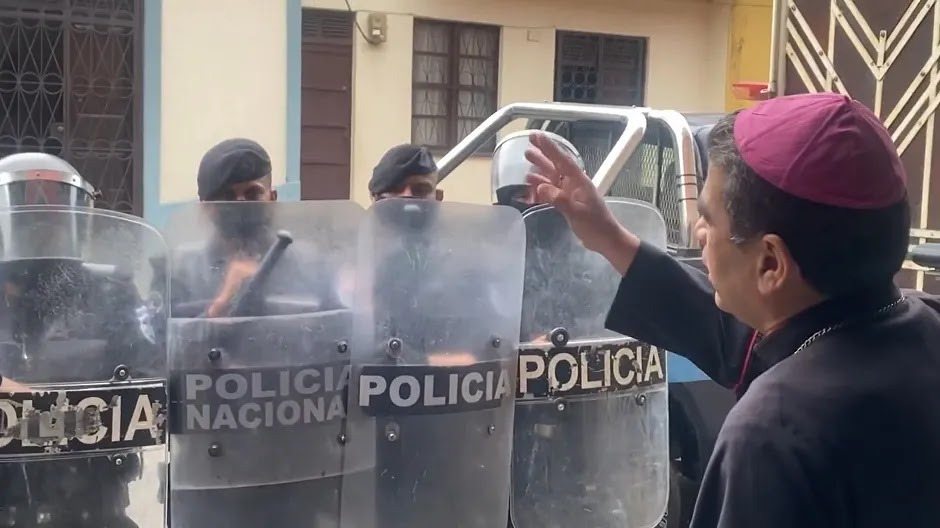
In recent days we’ve seen a striking example of this
in Bishop Rolando Álvarez of Nicaragua,
a kind of modern-day Jeremiah,
who has not been lowered into a well,
but has been placed under house arrest 
by the government of his country. 
A long-time thorn in the side 
of Nicaragua’s authoritarian rulers,
bishop Álvarez was charged 
with inciting violence
and, in a curious turn of phrase, 
“crimes against spirituality.”
I can only presume that in this case 
“spirituality” is supposed to refer to 
a way of practicing the faith
that comforts troubled consciences
and numbs the pain of oppression—
a faith that never causes offense,
never creates conflict,
never results in division,
never sets the world on fire;
a faith that aids and abets 
the false peace of domination.
Bishop Álvarez, like Jeremiah, 
rejects this sort of spirituality,
and so he is charged 
with being a source of conflict.

But we do not need dramatic examples,
like bishop Álvarez or Jeremiah, 
to know how faithfulness to Jesus’s gospel of peace
can uncover conflict, division, and tension.
We can look around our own nation and see
how faithfulness to the social teachings of the Church
on the dignity of all human life, 
migration and poverty,
the environment and war
will put you at odds 
with the platforms
of both major political parties.
We can look within ourselves
and feel the conflict between 
that part of us that is willing to settle
for a spirituality that comforts our conscience
and numbs the pain of life,
and that part of us 
that wants to follow Jesus no matter the cost,
knowing that, as the Letter to the Hebrews says,
“In your struggle against sin
you have not yet resisted 
to the point of shedding blood.”

But conflict is not the last word.
Even in the midst of the struggle
that comes with faithfulness to Christ
we can find true peace.
In a recent video message, bishop Álvarez said,
regarding those who have persecuted him,
“Our hearts are full of forgiveness. 
That’s why we’re at peace. 
Our hearts are full of the mercy of God, 
and so we’re at peace…. 
we are at rest in the hands of the Lord.”
Jesus, who passed through conflict into joy,
is “the leader and perfecter of faith,”
and has come to give us true peace—
not the false peace that hides conflict
beneath the cloak of power,
but the peace that the world cannot give,
the peace that overcomes conflict
through justice and mercy 
and self-sacrificing love:
the peace that sets the world on fire.
Let us pray that we would receive that peace,
that we would become that peace,
and that God would have mercy on us all.

Thursday, August 4, 2022

18th Week in Ordinary Time, Thursday

Reading: Jeremiah 31:31-34; Matthew 16:13-23

God says through the prophet Jeremiah:
“I will place my law within them, 
and write it upon their hearts…. 
No longer will they have need 
to teach their friends and relatives
how to know the LORD.”
While this may not be entirely good news
for those of us who teach theology,
which in its better moments
seeks to help people see how to know the Lord,
it does seem to be good news for humanity as a whole.
It is good news that we will no longer experience God’s law 
as something external to us,
something alien and imposed upon us,
for that means that we will know God, as Augustine put it,
as interior intimo meo: closer to me than I am to myself.
And, as St. John Vianney said, 
“This union of God with a tiny creature is a lovely thing. 
It is a happiness beyond understanding.”

And what Jeremiah proclaims as coming,
our Gospel suggests has already arrived.
For when Peter confesses Jesus to be
“the Christ, the Son of the living God,”
Jesus proclaims, “flesh and blood 
has not revealed this to you, 
but my heavenly Father.”
Peter did not learn how to know the Lord
from friends or relatives 
or those who thought Jesus might be
John the Baptist or Elijah or Jeremiah 
or one of the prophets.
The Father himself revealed Jesus to Peter
within the depths of his heart;
the Spirit, who is the new Law of the Gospel,
was written on Peter’s heart through faith.
The days that are coming
seem to have arrived.

But, of course, Peter’s faith is yet imperfect.
He still thinks not as God does
but as human beings do.
For he cannot accept that Jesus must walk
the path of rejection and suffering and death.
But this is the heart of God’s new covenant,
and to reject it is to become 
not the rock upon which Christ 
would build God’s Church,
but the stone of stumbling,
the obstacle that must be left behind.
What Peter could not accept,
what we so often cannot accept,
is that while God has promised 
to write his Law upon our hearts,
the instrument with which he does this writing
is the cross.

To have faith is to embrace the cross,
the cross upon which Jesus bore our sins,
and the crosses that we are called to take up,
the crosses through which we come, over time,
to be conformed to the one 
who laid down his life in love for us.
God’s promise is 
that “all, from least to greatest, 
shall know…the LORD.”
But to know the Lord is to know his cross.
Therefore, each of us, from least to greatest,
is called to take up our cross
so that God’s law, God’s Spirit,
might be written in our hearts.
And this is happiness beyond understanding.


Tuesday, August 2, 2022

18th Week of Ordinary Time, Tuesday

 
So, here’s the bad news:
your wound is incurable,
you bruise is grievous,
your running sore has no remedy
and your lovers have forgotten you. 
Your boat is being tossed by the waves
and the wind is against it. 
This is life under the condition of sin
when we justly suffer the consequences of our sin. 

Sometimes, of course, we get away with it,
at least for a time.
We don’t experience the consequences of our sin;
we even prosper and flourish and grow fat
on the fruits of our sin.
But, as God tells Israel through Jeremiah,
no one has escaped God’s justice:
“I struck you as an enemy would strike,
punished you cruelly.”
And when we are struck,
we come to a moment of realization
of exactly how dire our situation is,
exiles mourning and weeping in this valley of tears.

And this is also grace.
It is grace to recognize that we are in exile,
to recognize that our wound is incurable,
our bruise grievous,
our boat swamped
and the wind against it.
It is grace to awaken to the truth
that our sin has placed us in opposition 
to the very source of our existence.

But that is not the end of grace.
For Jesus walks toward us through the storm,
and calls to us:  
“Take courage, it is I; do not be afraid.”
And he calls us to come to him,
just as he called Peter.
He calls us to step into the storm unafraid;
as God says through Jeremiah:
“When I summon him, he shall approach me;
how else should one take the deadly risk.”
He calls us to trust that he comes 
not only in justice 
but also in mercy, 
to heal the wounds of sin
and to rebuild our ruined souls.

But, of course, the life of grace,
like life lived under the condition of sin, 
is not a moment but…well…a life.
And these two lives are intertwined.
We like Peter feel faith flow and ebb,
grow full and drain away,
flourish and whither
over and again.
We boldly step into the storm at one moment
and flail and sink the next,
and so our lives are a continuous calling out:
“Lord, save me!”
And this is right and just,
for the storm that rages 
is the flow of time in which we live,
it is our inconstant natures
that even under grace
suffer the sickness of sin.

But the glad tidings is that this sickness
is not a sickness unto death.
For Jesus has called us to him
and Jesus has grasped our hand and caught us
and Jesus will not let us go. 


Saturday, July 16, 2022

16th Sunday in Ordinary Time

Readings: Genesis 18:1-10a; Colossians 1:24-28; Luke 10:38-42

As I suspect was the case with many of you,
I was transfixed last week by the first images
coming from the James Webb Space Telescope.
They were not only beautiful,
but they made visible 
the immense size of the cosmos,
in which vast galaxies appear as tiny spots of light,
as well as its immense age,
capturing light that originated from stars
thirteen billion years ago,
at the very dawn of the universe.

That vastness-made-visible awakened in me 
feelings like those expressed by the 17th-century
scientist and philosopher, Blaise Pascal:
“When I consider the short duration of my life, 
swallowed up in an eternity before and after, 
the little space I fill engulfed in the infinite immensity 
of spaces whereof I know nothing, 
and which know nothing of me, I am terrified. 
The eternal silence of these infinite spaces frightens me.”

And yet, at the same time, 
these very same images elicited in me 
a sense of wonder and gratitude,
and the thought that 
what is important about human beings
is not our physical place in the universe,
but the fact that we, 
fragile creatures that live
on a small rocky formation 
in an obscure corner of the cosmos,
sustained and protected 
by a thin layer of gas clinging to its surface,
limited in time and space,
can look up into those silent, infinite spaces
and bring into ourselves
the vastness and beauty of the universe 
through the miracle of thought and understanding.
Pascal went on to say:
“By space the universe encompasses 
and swallows me as an atom… 
by thought I comprehend the world. 
Man is but a reed, 
the most feeble thing in nature; 
but he is a thinking reed.”
Our discovery of the scope of the cosmos
should increase our sense of awe and wonder 
at the power of God’s creative activity
and at the immense privilege of being 
witnesses to that activity,
the glory of knowing even a small slice
of what God is doing in creation.

This sense of awe mixed with terror, 
this sense of a mystery beating in the heart of things
and holding our universe in existence,
is something we as Christians share with all people,
even those who do not call this mystery
by the name “God.”
Who knows? 
Perhaps this sense of awe and mystery
is shared by other intelligent beings—
other “thinking reeds”— 
living on other rocky formations
in other obscure corners of the cosmos.

But, St. Paul reminds us today,
our Christian faith tells us
that there is an even greater mystery 
at work in our world,
for the infinite creative force
that holds the universe in existence
has come to dwell among us in the flesh,
a fragile reed among other fragile reeds,
so that we might know the fullness 
of the riches of his glory 
and live eternally in the light of that glory.
Paul makes it his life’s work to reveal to all people
“the mystery hidden from ages 
and from generations past”
but now made known to God’s holy ones:
the mystery of the infinite power of God
present among us in Jesus Christ crucified.

In our Gospel today we see
Mary of Bethany sitting at the feet of Jesus,
heedless of her sister’s complaints,
because she sees the mystery
that Martha is too busy to recognize:
that the creative force that forged the cosmos
and adorned it with such beauty
is present in the flesh,
as a human being,
in their home,
on a fragile rocky formation
in an obscure corner of the cosmos.
Mary sits at the feet of Jesus 
because she knows that in his presence
she is in the presence of divine glory,
a glory surpassing the beauty
of the stars and galaxies and nebulae
that so captivated us this past week.
She has found the one thing necessary;
she has chosen the better part
and it will not be taken from her,
for it will lead her into eternity.

Pascal saw in the vastness of the cosmos
cause for both wonder and terror.
But he also saw within himself
an even more vast emptiness.
He wrote, “There is a God-shaped void 
in the heart of each person 
that cannot be satisfied 
by any created thing 
but only by God the Creator, 
made know through Jesus Christ.”
The vastness of creation—
the unimaginable scope of space and time—
is mirrored within us by an equally vast yearning,
and knowing this vastness without knowing Jesus Christ
can lead us to despair,
for what hope can we fragile reeds have
amidst such immensity
if all we know is our own fragility?
But in Jesus Christ God has come among us
with a human face and a human heart
to fill the empty space within our own hearts,
to reveal to us the mystery of eternal love
here on this tiny rocky formation 
in this obscure corner of the cosmos.
Pascal writes that because Christ shares 
our human condition,
“Jesus is the God whom 
we can approach without pride 
and before whom 
we can humble ourselves without despair.”

Paul tells us that Christ in us is the hope for glory,
a glory surpassing anything 
that we poor thinking reeds can conceive.
As we ponder the beauty 
and terror of the cosmos,
let us ponder as well 
the hope of glory revealed in Christ,
and let us pray that God would give us that hope,
that God would fill us with that glory,
and that God would have mercy on us all.


Saturday, July 2, 2022

14th Sunday in Ordinary Time


In our first reading, the prophet Isaiah 
offers an interlocking set of images:
the image of the human mother who feeds her child 
from the substance of her own body;
the image of God as a mother
who seeks to comfort and console us
in our need and in our fear;
and the image of the city of Jerusalem as a mother
whose nurture and whose care extend to all her children.
Each of these images is worthy of our attention.

First, we have the image 
of the human mother and her child.
We have heard a lot, in recent days, 
about the relationship of mother and child,
a relationship that is, as a matter of biological fact,
unique in its intimacy and in its complexity,
in its intricate intertwining of two lives,
particularly during the months of pregnancy,
but continuing in the years that follow. 
If those on opposite sides of the question
of the legality of abortion agree on nothing else
(and it sometimes seems that they agree on very little),
all acknowledge the uniqueness of that relationship
and its life-changing power.
Indeed, it is precisely this uniqueness and power
that makes the issue so volatile, and so important,
and why the Church teaches the need 
to protect and foster that relationship
in ways that honor both mother and child.

Second, we have the image of God as a mother, 
which might be initially startling,
accustomed as we are to praying to God as Father.
Isaiah suggests, however, 
that in the unique and complex intimacy
of the relationship of mother and child
we see an image of God’s intimacy with us,
an image of the God who brings us 
to birth in the order of nature
and rebirth in the order of grace.
Indeed, some saints have suggested 
that we see in the pains of Jesus on the cross
the labor pains of God incarnate
bringing forth that new creation
of which Paul speaks in our second reading.
Julian of Norwich, writing in the 14th-century, 
says, “our true Mother, Jesus, who is all-love, 
gives us birth into joy and endless living.” 
As Isaiah and Julian suggest,
the image of God as mother
surely has an important place among
the many metaphors that we use
to speak of the mystery of God’s love,
and should shape our understanding
of the dignity of human motherhood.

Finally, we have the image 
of the city of Jerusalem as a mother,
who shares her abundance with all her children.
Isaiah shows us God not simply promising
that the city will prosper,
but that her prosperity will be 
spread abroad among her children, 
reaching far and wide 
so that all will receive her motherly care.
This vision is at the heart 
of the social teachings of the Church:
the political community exists to ensure
that the goods that God 
has lavished upon the world
are shared in justly by all people, 
most especially the weak and the vulnerable.
We might have legitimate disagreements 
on the precise balance 
between public policy and private initiative
in this distribution of goods,
but for us as Catholics 
whatever way we strike that balance
must respect the Church’s teaching that,
as St. John Paul II put it back in 1981,
“the right to private property is subordinated…to the fact 
that goods are meant for everyone” (Lab. Ex. §14).
Or, as St. Ambrose put it in the 4th century,
somewhat less technically and with a bit more bite,
“The earth belongs to everyone, 
not to the rich” (De Nabute c. 12 n. 53).
Saints John Paul and Ambrose teach us 
that our vision for our own city, state, and nation,
no less than Isaiah’s vision for the holy city Jerusalem,
should be of a community in which all are given
what they need, not simply to survive, but to flourish,
and that our politics must be rooted not in self-interest,
no matter how enlightened,
but in concern for the least of these our brothers and sisters.

In recent days many people have said
that with the overturning of Roe versus Wade
the time has come for the pro-life community 
to step up and advocate
for an economic and social order 
that will address the inequalities 
that have often led women
to seek abortion as a solution 
to an unexpected or undesired pregnancy.
This seems largely correct,
though I would add that this is something 
that some have been doing all along.
But more needs to be done,
and more of us need to do it,
and this must be a matter of concern for our nation
and not simply for us as private individuals.
Saint John Paul wrote,
“it is not enough to remove unjust laws…
[T]here need to be set in place 
social and political initiatives 
capable of guaranteeing conditions 
of true freedom of choice 
in matters of parenthood” (Ev. Vitae §90).

Our Catholic faith calls us to embrace fully 
what John Paul called “the Gospel of Life,”
which focuses our concern on life 
at its most vulnerable stages—
its beginning and its ending—
but also addresses questions 
of economic justice, war, the death penalty,
the dignity of migrants, and the environment.
All of these are elements 
of what John Paul called “a culture of life,”
a culture that embraces its children 
as a mother embraces her own,
feeding and nurturing them,
a culture that we are called to labor for,
by word and example,
as we make our journey to God’s kingdom.
We must answer this call, 
going forth gently, like lambs among wolves,
armed with nothing but the love of God.

The task lies before us.
The harvest is abundant.
Let the laborers not be few.
May God, who cares for us 
as a mother cares for her child, 
prosper the work of our hands,
and may God who is merciful
have mercy on us all.


Saturday, June 11, 2022

Trinity Sunday


In our Creed we say, 
“I believe in God, the Father almighty…”
and “I believe in one Lord Jesus Christ,
the Only Begotten Son of God…”
and “I believe in the Holy Spirit,
the Lord, the giver of life.”
Notice that we do not say,
“I believe that God is the Father almighty…”
or “I believe that the one Lord Jesus Christ,
is the Only Begotten Son of God…”
or “I believe that the Holy Spirit
is the Lord, the giver of life.”
In the Creed we profess at Mass 
we do not simply state the content of our belief—
what we hold to be the case about God—
but we make an act of personal commitment.
It is about believing in 
as much, if not more, 
than it is about believing that.

Of course, the Creed does state 
what it is that we believe 
about the Father, the Son, and the Holy Spirit.
In particular, it states that we believe
that the Son, and by implication the Holy Spirit,
are “consubstantial with the Father”—
that is to say, the Son and the Holy Spirit,
while being distinct from each other 
and from the Father,
are just as much God as the Father is,
and everything that is true of the Father as God—
eternity, omnipotence, omnipresence, and so forth—
is true of the Son and the Spirit as well.
We most definitely believe that this is the case,
and this is what we call the doctrine of the Trinity.

But saying the Creed, 
like the rest of our lives as Christians,
is not ultimately a matter of 
accepting facts about God. 
To say the Creed is not 
to recite the answer to a puzzle
but rather it is to let ourselves be drawn 
into the mystery that is 
at the very heart of existence,
the mystery that we call “God.”

Saint Augustine distinguished three different ways
we might speak about believing (Tractates on John, 29).
First, there is what he calls in Latin credere Deum,
that is, affirming that there is a God
in the way that we might affirm
that there is grass on the ground 
or clouds in the sky.
We assent to the fact of God’s existence,
though, of course, even the devil does that.
Second, there is what he calls credere Deo
a change of a mere two letters—
and this is to “believe God,”
that is, to accept something 
because God has revealed it.
Finally, there is credere in Deum,
that is, to believe in God.
This is not simply to affirm 
that there is a God,
or to affirm what God has revealed,
but is to make God the object of our love
and the goal of our living.
This is to promise ourselves to God:
to ask God to be our God
and to commit ourselves to be God’s people.

And this is what we do when we say the Creed.
St. Thomas Aquinas says that faith 
weds the soul to God (Exp. in Symb. Apost. a. 1),
so we might think of saying the Creed
as something like speaking wedding vows.
When a couple marries, the vows they make
involve both a belief that and a belief in.
I vow myself to you because I believe 
that you are a good person, a loving person,
an honest and steadfast person.
But more than that, my vows are the sign
that I believe in you:
I profess my faith that you will be good to me,
and I will be good to you;
that you will be loving to me,
and I will be loving to you;
that you will be honest and steadfast to me
and I will be honest and steadfast to you.
In believing in you, I join my life to yours,
I join my fate to yours,
I say, wherever you go, I will go,
until the day I die.
In making this vow,
I come to dwell in our shared love.
 
And when we say the Creed,
we certainly say that God is Father, Son, and Holy Spirit.
But more than that, we entrust ourselves,
when the world seems empty of meaning,
to the God who made all things good,
who plays upon the surface of his earth
and finds delight in the human race.
We entrust ourselves, when we have sinned,
to the God who has made peace with us 
through Jesus Christ
and in whose grace we stand. 
We entrust ourselves, when the future is uncertain,
to the God who has promised to us the Spirit of truth,
who will guide us into all truth.

And in so entrusting ourselves,
our soul comes to dwell in the eternal mystery of love,
the love that existed before the world was made:
“when there were no depths…
when there were no fountains 
or springs of water;
before the mountains 
were settled into place,
before the hills.”
To believe, not simply that there is a God,
but to believe in God,
is to dwell in the mystery of timeless love 
that we call the Trinity,
not because of anything that we do,
but because God 
has taken delight in the human race,
because God has made peace with us
through Jesus Christ,
“because the love of God 
has been poured out into our hearts
through the Holy Spirit 
that has been given to us.”

I believe in one God:
Father, Son, and Holy Spirit,
the mystery of love
to whom our soul is wed in faith.
May this merciful God 
have mercy on us all.

Saturday, May 28, 2022

Ascension


Last Tuesday, twenty-one people, 
nineteen of them young children,
were killed in the school shooting in Uvalde, Texas.
Ten days earlier, ten people, all of them Black, 
were killed in a racist hate crime in Buffalo, New York. 
And lest we forget, distracted by fresh horrors,
some 4000 Ukrainian civilians have been killed so far
in Russia’s unjust war in their country. 

I find myself thinking that it would be awfully nice
to be able to rise like Jesus up above this earth,
to enter a place of eternal heavenly rest
above the sorrow and pain that human inflicts on human, 
above the violence and madness that infects us,
above the self-interest and complacency that make us
go on as if these sorts of things are normal or tolerable.
It would be nice to escape this earth we have soaked
with the blood and tears of the innocent.

But the Ascension is not about escape.
It is not about Jesus being plucked from this vale of tears.
It is not about Jesus leaving behind the world’s sorrows,
and even less about him leaving behind we who are sorrowing.
We pray in our liturgy this day:
“he ascended, not to distance himself from our lowly state
but that we, his members, might be confident of following
where he, our Head and Founder, has gone before.”
He ascended not to separate himself 
from the blood and tears of the innocent,
but to bring that pain into the healing light of God.
He ascended not to leave us behind
but so that he might be our great high priest in heaven,
interceding for us before the Father through the Spirit.
He ascended so that our lowly state might touch eternity.

In the Eucharistic Prayer, 
after the gifts have been consecrated—
gifts of bread and wine that we offer
as symbols of our loves and labors,
the bread of life and affliction,
the wine of joy and cup of sorrow,
now transformed into the body and blood of Christ—
the priest prays in our name:
“command that these gifts be borne
by the hands of your holy Angel
to your altar on high
in the sight of your divine majesty,
so that all of us, who through this participation at the altar
receive the most holy Body and Blood of your Son,
may be filled with every grace and heavenly blessing.”
In our celebration of the Eucharist, 
Christ becomes once more present among us,
and is once more lifted up by the angels,
and, as our great high priest, lays our human lives—
their joys and hopes, their anxieties and sorrows—
upon the heavenly altar,
so that we, who receive him at this earthly altar,
might taste eternity in him.

In the days that have followed since last Tuesday,
various media outlets have published pictures 
of the twenty-one people who were murdered.
Each of them is heart-breaking and gut-wrenching, 
but one has repeatedly caught my eye.
It is the picture of Jacklyn Cazares, age nine.
It is a picture from her first Holy Communion,
in her white dress, with a crown of white flowers in her hair.
She smiles with the joy of that day,
that day her life was laid by Christ on the altar on high,
that day she was filled with every grace and heavenly blessing.
Without in any way ceasing to be heart-breaking,
it is for me also an image of hope:
hope in Jesus Christ risen and ascended,
hope amid terror and strife,
hope for life and healing 
in God’s eternal light.

Hope, however, is not simply consolation.
Hope is also challenge.
Hope challenges us to ask, even as we mourn,
what is God calling us to do?
Hope tells us that, even if we cannot fix the world,
even if we cannot absolutely guarantee
that such horrors will never happen again, 
we also are not allowed to do nothing.

The U.S. bishops have noted several concrete measures
that could be tried to reduce the incidence of gun violence:
from mandatory background checks for gun purchases,
to improved mental health services,
to federal laws that criminalize gun trafficking,
to an honest assessment of the effect on people
of the images of violence that pervade our society.
We cannot know for sure 
that any of these things will save lives,
but hope calls us at least to try.

But that is not the only role that hope has to play.
So many in our society live
with a pervasive sense of hopelessness,
a hopelessness that leads people 
to lash out against the world.
This seems to have been the case 
with the killer in Uvalde,
who was bullied at school
and faced conflict at home,
who saw no hope in the world
that his life could ever be different.
Here is where the challenge of hope,
the challenge of following Jesus,
becomes really difficult.
The governor of Texas called him 
“the face of pure evil,”
but, looking with eyes of faith, love, and hope 
we should see a broken child of God,
starving for hope.

To see in this way is, of course, 
impossible for us to do
apart from God’s gift of grace.
But we who have been lifted up with Christ,
whose lives have been laid by him on the altar on high,
have been filled with every grace and heavenly blessing
and given the mind of Christ with which to see.
And he calls us now, not to escape, 
but to be his body in the world,
a world soaked with the blood 
and tears of the innocent,
a world hungry for hope, 
hope that we make visible in our actions.
May God strengthen us 
for this task to which he calls us,
may God raise up the dead 
and comfort the sorrowing,
and may God have mercy on us all.