Saturday, April 22, 2023

Easter 3


“He was made known to them 
in the breaking of bread.”
Not when he appeared beside them,
walking along the road;
not when he interpreted to them 
what referred to him
in all the Scriptures;
not when he accepted 
their invitation to stay with them,
since it was nearly evening
and the day was almost over;
not even when he sat down 
with them at table.
But only when he took bread
and blessed
and broke
and gave.

Not just bread,
but broken bread.
Not the artfully shaped loaf
fresh from the oven;
not the neatly sliced Wonder Bread
in its plastic sleeve;
not even the perfect round host,
right-sized for individual consumption;
but bread broken and torn,
passed from human hand to human hand.

Why the breaking of bread?
Why this act to open their eyes 
to his risen presence?
Why this act to open our eyes
to his presence among us today?

We know him in the breaking of bread
because to know Jesus Christ 
is to know him crucified and risen,
which is to know him as the one 
broken by human hands,
the one whom we killed,
“using lawless men to crucify him.”
It is to know him as the one
whom his Father would not 
abandon to the nether world
nor let his flesh see corruption.
It is to know him as 
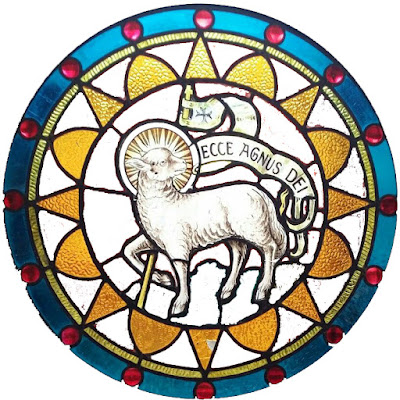
the spotless unblemished lamb,
known and loved by his Father 
before the foundation of the world
but revealed to us in these last days.
We know him in broken bread
because we know him 
as the reconciling sacrifice
that rescues us from futility
and makes our peace with God;
we know him as the one who seeks out
those who would flee his presence;
we know him as the one 
who lets his life be broken
so that each of us might have a share in it.

We know him in the breaking of bread
because we cannot know him 
in our isolation 
but only in our gathering.
Christ cannot be known in my bread,
but only in our bread—
we pray, “give us this day our daily bread”—
and in order to become our bread
Christ must be broken and shared.
As St. Paul writes, “The bread that we break, 
is it not a participation in the body of Christ? 
Because the loaf of bread is one, we, though many, 
are one body, for we all partake of the one loaf”
(1 Corinthians 10:16-17 ).
As St. Thomas Aquinas teaches, 
“The unity of the mystical body 
is the fruit of the true body received”
(Summa theologiae III q. 82 a. 9 ad 2).

Our unity in Christ involves the breaking of his body.
This truth is perhaps obscured by the custom
of using individual host for communion,
but even so, at every Mass, 
the priest ritually breaks the bread
as we sing to Christ the Lamb who was slain,
begging him for mercy and for peace.
For it is only by the gift of his mercy and peace
that we are united to Christ the head;
it is only by his mercy and peace
that we who are many can become one body
by sharing in the bread that has been broken.

He is made known to us in the breaking of bread
because our unity in Christ is a costly unity,
a unity of sacrifice and sharing.
It is costly because it is our unity 
within the body of the one who, 
though risen,
still bears the marks of his breaking,
the one who makes his flesh the bread of heaven
by consecrating it on the cross to God.
It is costly because if I am to eat 
the bread of heaven,
I must give up my bread for our bread,
and in so doing I may find myself 
in communion with those 
whom I don’t very much like,
but whom I am called to love 
as Christ himself.

Sacrifice and sharing,
consecration and communion:
these pretty much sum up what happens
each time we break bread,
each time we celebrate the Eucharist.
And they pretty much sum up the Christian life.
The broken bread Christ gives to us
draws us into his sacrificial love
by drawing us into the life of his body.
In every Eucharist we celebrate 
we can see this happen,
for in the breaking of bread
the veil is pierced 
between this world and God’s eternity,
and our eyes are opened.
And like those disciples at Emmaus
we return to the road,
carrying with us the news of resurrection,
fragments of the bread of heaven
scattered in the world 
in the time of our sojourning,
but yet united to him and each other
in faith, hope, and love.
Lamb of God, 
whose breaking makes us whole,
grant us mercy,
grant us peace.

Thursday, April 6, 2023

Holy Thursday


Preached at Corpus Christi Church, Baltimore.

The book of Genesis mentions in passing
that Joseph, the son of Jacob,
whose brothers sold him 
into slavery in Egypt,
was given a wife by the Pharaoh,
a woman named Asenath, 
daughter of an Egyptian priest.

That is pretty much all we are told about her.
But the human imagination being what it is,
a Jewish writer living around the time of Jesus
took these few verses and invented
an entire romance about Joseph and Asenath,
which Christian writers later took and adapted.
The story involves the couple 
facing trials and tribulations,
not least because Asenath 
is the daughter of a priest serving false gods,
and so an unsuitable match
for a descendent of Abraham like Joseph,
as well as the fact that she lives secluded in a tower,
scorning the advances of the many young men
who are beguiled by her beauty.
Her attitude changes, however, 
when she happens to catch a glimpse of Joseph,
but he still rejects her because she is an idolater.
The archangel Michael intervenes,
visiting Asenath and giving her 
a miraculous honeycomb to eat,
which he declares to be 
the bread of heaven
and the cup of immortality.
Joseph shows up, 
having also been visited by the angel,
who tells him of Asenath’s liberation from idolatry.
There follows a good bit of embracing and kissing,
described in some detail.

What does any of this have to do with Holy Thursday?

A pivotal scene occurs when Joseph and Asenath
go to the house of her father to make official their betrothal.
Like any good host in the ancient middle east,
Asenath’s father calls for a maid to come wash Joseph’s feet,
but Asenath will have none of it.
She says to him, “your feet are my feet, 
and your hands are my hands, 
and your soul is my soul, 
and another shall not wash your feet”
(Joseph and Asenath §20).
The washing of feet is, for Asenath,
an act of spousal intimacy.

When Jesus washes the feet of his disciples
he is abandoning his role as rabbi,
since teachers did not wash 
the feet of their students,
and he is taking up the role of spouse:
the role of one whose flesh 
has been joined to their flesh,
one whose soul 
has been joined to their soul.
At that last supper with them before he dies
Jesus does not stand among them as teacher
but joins himself to them as spouse,
in the most intimate of bonds.

I think anyone who has participated 
in the washing of feet on Holy Thursday,
either as the washer or the one washed,
has sensed the intimacy of this act.
This is what makes it 
somewhat uncomfortable, 
somewhat embarrassing,
since those involved are often
relative strangers to one another.
This is also what give it its power.
Christ becomes our spouse,
and we are joined to him
and in spousal intimacy with each other.

This, of course, is what happens at every Eucharist.
Not only the yearly ritual of washing feet
but the daily ritual of the Mass
is about the intimacy of Christ with us,
and our intimacy with each other.
In sharing the eucharistic banquet
we eat the bread of heaven
and drink the cup of immortality;
Christ’s flesh becomes our flesh,
and we become one body with each other,
joined together through our union in him.
On this night, 
and indeed at every Mass,
Christ says to us,
and we say to each other,
“your feet are my feet, 
and your hands are my hands, 
and your soul is my soul.”

But this night is not simply a night of intimacy.
It is also a night of betrayal.
Indeed, it is a night of intimacy betrayed.
Both Judas and Peter,
whose feet Jesus washes, 
to whom he has joined himself
in spousal intimacy,
will, each in his own way,
soon betray Jesus.
To betray someone with whom 
you have become one flesh and one soul
is to engage in that self-destroying action
that we call mortal sin.

I spent most of yesterday afternoon
reading through the Maryland Attorney General’s
report on sexual abuse by Catholic clergy
over the past sixty years.
It is nearly 500 pages that document
gruesome horror after gruesome horror,
both the acts committed
and the callous treatment of victims
who courageously reported these crimes.
But most of all, 
it is nearly 500 pages of intimacy betrayed,
because nearly all of the abusers were priests
who used their status as those 
who are anointed to represent Christ,
as those who celebrate
the sacrament of eucharistic intimacy,
to prey upon vulnerable children and adults.

I do not have an explanation or an excuse,
nor even an apology adequate to the betrayal.
But on this night I will say two things.

First, if we wish to see Jesus in our midst,
we should look to the victims of these crimes,
for it is in them that we will find the ones
in whom intimacy was betrayed:
it is in them that we see the Man of Sorrows;
it is to them that the Church has played the role of Judas;
it is for them that we must seek justice and healing;
it is to them that we must say
“your feet are my feet, 
and your hands are my hands, 
and your soul is my soul.”

Second, we end this night
on which we commemorate Christ’s intimacy with us
in a moment of fear and uncertainty.
We end in waiting, in flickering fear-filled hope.
At this moment of betrayed intimacy
it is hard to see how God can make a path forward.
But the hope of Easter,
the hope of our lives as disciples,
is that betrayal is not the last word.
The hope of Easter 
is that God is greater than our sin;
that God can bring sinners to repentance 
and turn victims into survivors.
The hope of Easter
is that what lies ahead of us is an empty tomb,
the stone of betrayal rolled away,
our intimacy in Christ restored.

But on this night,
as we wait for a resurrection
we cannot yet see,
the task before us is clear:
“I have given you a model to follow,
so that as I have done for you, 
you should also do.”

Saturday, April 1, 2023

Palm Sunday


Last year, the philosopher Agnes Callard
published a column in the New York Times
reflecting on the phenomenon of social media pile-ons,
or what are sometimes referred to as “Twitter mobs.”
Someone says something 
that others find in some way offensive,
and critique cascades into denunciation, vilification,
and even death threats
as more and more people join the chorus,
convincing themselves that the offending party
must be shamed and somehow expelled 
from the realm of public discourse 
in order to restore purity
to the community constituted
by right-thinking people.

In her column, Callard counsels her friends
that, if such a thing should ever happen to her,
they should not rush to defend her from the mob,
as consoling as she might find such a defense.
As she provocatively puts it,
“If you care about me, 
let them eat me alive.”

She says this because of her conviction
that there is no way to argue a mob out of its rage,
out of its passion to shame and vilify,
since the logic of the mob is an illogic,
an irrational conviction about 
the unique evil of a single person
and how the elimination of that person 
will purify the world.
The mob convinces itself that it represents 
the right-thinking people of the world,
when in fact it isn’t thinking at all.
To act collectively against the mob,
to try to shout down its angry cries,
is simply to enter the mentality of the mob,
to succumb to its contagion.
As Callard puts it:
“You imagine that you are fighting against the mob, 
but actually you are becoming a part of it. 
Within the mob there is no justice 
and no argument 
and no reasoning, 
no space for inquiry or investigation. 
The only good move is not to play.”
The only good move, we might say, 
is to let the rage of the mob 
burn itself out.

Jesus seems to agree.
Throughout the story of the Passion,
Jesus refuses to play the mob’s game.
His actions fulfill Isaiah’s prophecy:
“my face I did not shield
from buffets and spitting.”
When one of his followers draws a weapon
to defend Jesus from the large crowd
who have come with swords and clubs to arrest him,
Jesus says, “Put your sword back into its sheath,
for all who take the sword will perish by the sword.”
When questioned by the high priest’s council,
which has transformed itself
from an instrument of justice
into an agent of mob violence,
Jesus remains silent, except to quote scripture:
“From now on you will see ‘the Son of Man
seated at the right hand of the Power’
and ‘coming on the clouds of heaven.’”
When dying in agony on the cross,
with the crowd reviling and mocking him,
he again speaks no word but God’s word, 
crying out in the voice of the psalmist:
“My God, my God, 
why have you forsaken me?”

Of course, there is a key difference 
between the mob Agnes Callard is speaking of
and the mob Jesus confronts in the passion story.
Callard’s mob is a virtual mob,
and its threats, by and large, are virtual threats:
the prospect of public shaming
and expulsion from the realms
of right-thinking discourse.
You can stoically resign yourself to such shaming
and wait for the mob’s anger to burn itself out.
But the mob Jesus faces does not want 
to shame or “cancel” or “de-platform” him.
It wants to kill him. 
The silence of Jesus,
his refusal to defend himself
or let his friends defend him,
is not simply a strategy 
of waiting out the mob’s rage
by enduring its shame.
For the rage of this mob will consume him,
not simply metaphorically,
but literally. 
The irrational, unjust, cruel conviction
that he must be removed 
from the realm of life itself
crashes over him and crushes him.
Stoic patience and resignation cannot save him.

Resignation cannot save him,
but resurrection can.
“I have set my face like flint,
knowing that I shall not be put to shame.”
Jesus faces the mob, defenseless and silent,
for he knows that humbling himself
for the cause of God’s kingdom,
“becoming obedient to the point of death,
even death on a cross,”
is the prelude to glory.
The ultimate answer 
to the violence of the mob,
to its irrationality, injustice, and cruelty,
to the contagion of sin that affects our race,
is God’s vindication of Jesus
by raising him to new life,
so that every power 
on heaven and earth and below the earth
would bow down before the humiliated one
now glorified.

As we enter this most holy of weeks,
let us set our faces like flint,
walking with Jesus 
on his silent, defenseless journey
from the shame of death 
to the glory of resurrection.

Saturday, March 18, 2023

Lent 4


In our Gospel today there seem to be 
a lot of people who just do not get 
what is really going on.
The disciples ask a question about sin
that appears to be completely off-track;
the blindman’s neighbors get into a debate
about whether it is really the same person 
who was blind but now can see;
and the Pharisees ignore the healing 
so they can accuse Jesus of breaking the Sabbath.
All of those who think that they can see
seem to be unable to figure out 
what is happening before their eyes.
They see a blindman, 
and ask the wrong question;
they see a healed man, 
and launch into a pointless debate;
they see the Word of God at work, 
and accuse him of sin.
They think they can see, 
but the light of the world
is darkness to them.

All of this is only to be expected
in the world of John’s Gospel.
John tells story after story 
about people being clueless,
not getting the point,
misunderstanding Jesus.
Nicodemus doesn’t understand 
what Jesus means by being “born from above”;
the woman at the well doesn’t understand
what Jesus means by “living water”;
the crowd doesn’t understand
what Jesus means by “bread from heaven.”
At every turn, Jesus is misunderstood.

But John warns us about this from the outset.
He writes in his very first chapter,
in the opening verses of his Gospel:
“the light shines in the darkness, 
and the darkness… auto ou katelaben.”
Now, this Greek phrase might be translated,
as our lectionary does,
“has not overcome it,”
and this is quite correct,
both linguistically and theologically:
the darkness does not overcome the light
that shines forth in Christ.
But the phrase can also be translated
as “has not comprehended it”
or maybe “has not grasped it,”
and this too is quite correct,
both linguistically and theologically:
the darkness does not grasp the light,
the darkness does not get it.
In his typically ironic fashion,
John is saying two things at once:
the light cannot be overcome by darkness
because darkness cannot comprehend the light.

Those who fail to understand Jesus
show themselves to be in darkness.
And to grasp fully who Jesus is, 
and the truth of what he says and does,
is to pass, like the man born blind,
from darkness to light.
It is to seek to see, 
not as human beings do,
judging by appearance,
but as God sees,
looking into the heart.
It is to live as a child of light,
producing “every kind of goodness
and righteousness and truth.”

But there can be a temptation for us here.
We can be tempted to think 
that the world divides up neatly
into light and darkness.
We can be tempted to think that we 
who have been marked with the waters of baptism,
who profess Jesus as the world’s Lord and light,
and who come faithfully to church on Sunday,
must surely be standing fully on the side of light, 
must surely be seeing as God sees,
must surely be living as children of light.
Surely we must be the ones who comprehend the light,
the ones who get what is really going on.

The season of Lent, however, 
tells us something different,
for Lent reminds us of our own blindness.
The annual return 
of this season of repentance and conversion
tells us that, in this life, we never grasp fully
the light that has come into the world.
Our lives are punctuated each year
by the call to turn away from sin 
and believe in the Gospel.
Our lives are punctuated each week
by our confession that we have sinned
through our own deliberate fault.
Our lives are punctuated each day
by our prayer that God 
would forgive us our trespasses.
Lent reminds us 
that the line between darkness and light
lies not outside us but within us,
that even we who have truly 
become light in the Lord
must hear again the call:
“Awake, O sleeper,
and arise from the dead,
and Christ will give you light.”

“I came into this world for judgment,
so that those who do not see might see,
and those who do see might become blind.”
Jesus comes as the light of the world
to illuminate the dark corners of our hearts,
so that the truth might be manifest,
and all our masks and pretenses be stripped away.
To see this light is both 
to be dazzled by its brilliance
and to comprehend our own blindness.
It is to see that we ourselves are often
those who just don’t get what is really going on:
who ask the wrong questions,
who engage in pointless debates,
who accuse others of sin.
But it is also to see the possibility of joy,
for it is to see that our darkness 
cannot overcome that light—
that even if we cannot grasp it,
it has grasped us,
and it will not let us go
until the last dark corner of our soul
is flooded with the light of glory.
May these remaining days of Lent
be for us ones of light and joy in the Lord
and may God have mercy on us all.


Saturday, February 11, 2023

6th Sunday in Ordinary Time


“What matters in the end
is not what you do
but what is in your heart.”
That sounds nice, doesn’t it?
It suggests that God 
is not concerned
with our obeying God’s Law,
as the scribes and Pharisees 
seem to have thought,
but with our intentions.
God will not judge me
on the basis of what I have done
and what I have failed to do—
through my fault,
through my fault,
through my most grievous fault—
but on what I intended to do,
what I hoped to do,
what I wanted to do.
And the message of our Gospel today
suggests that this is, in fact, the case.
What matters is not what you do
but what is in your heart.

But here’s the bad news:
Have you looked into your heart lately?
Have you seen what’s in there?
Have you tried to do something about it?
It turns out, it is a lot easier 
to control your actions
than to control your heart.
Despite our moral struggles,
most of us manage to avoid 
committing murder or adultery.
But how many of us 
avoid anger or lust?
How many of us have souls
that are free of jealousy and irritation
and prejudice and greed
and pride and pettiness?
Even if we want to be free of these things,
they seem firmly lodged within us.
What matters is what is in our hearts,
but what is in our hearts can be pretty ugly
and seems pretty much beyond our control.

What matters is what is in our hearts
because it is our souls, not our bodies,
that lie at the root of our failure
to live as God would have us live.
St. Augustine criticized those Greek philosophers
who held that it was the body that corrupted the soul.
In fact, he said, the opposite is true:
“it was not the corruptible flesh
that made the soul sinful,
but the sinful soul
that made the flesh corruptible (Civ. Dei 14.3).
It is the soul that turns us from God,
the source of all life,
and toward ourselves;
it is the soul and its passions
that lead the body into acts of anger and lust,
that lead our hands to steal,
our ears to listen gladly to gossip,
our mouths to speak lies
or words of cruelty.
Jesus says, to have righteousness 
that surpasses that of the scribes and Pharisees,
and so enter the kingdom of heaven,
it is not enough to present 
an outward appearance of goodness;
we must possess a goodness that goes
all the way down.
Paul tells us that “the Spirit 
scrutinizes everything, 
even the depths of God.”
And if the Holy Spirit can scrutinize the depths of God,
surely the Spirit can scrutinize the depths of my soul.
I may fool some people with my pious actions,
but I cannot fool the Spirit of God,
who sees into my heart.

This all seems like pretty bad news.
But here is the good news:
the Spirit scrutinizes 
not in order to condemn,
but in order to convert.
The Spirit’s comes into our hearts
to teach us the hidden wisdom of God,
the wisdom that we must have 
in order to choose life over death,
good over evil,
to enter the kingdom of heaven.
The Spirit dwelling within us 
is the New Law that teaches us
how to walk in the ways of God
not only in our outward actions
but in the depths of our soul.
But if this is so,
if we have received God’s Spirit,
why is it that our hearts are still beset
by anger and lust,
by jealousy and irritation,
by prejudice and greed?
What is the Spirit waiting for?
Why is the Spirit so slow?

Perhaps the Spirit works slowly
because the human heart is a delicate thing.
In theory the Spirit could convert us
in the blink of an eye,
cracking open our stony hearts,
rooting out our anger, 
lopping off our lust.
And people do sometimes undergo
dramatic interior conversions.
But in many hearts 
the weeds grow amid the wheat,
the evil is entwined with the good,
and so the Spirit works within our hearts
like water dripping on a stone:
slowly wearing it away bit by bit,
smoothing out its roughness over time.
Our anger slowly abates,
our lust gradually lessens,
we grow in compassion and mercy toward others
as we experience God’s compassion and mercy
shown to us. 
If we cooperate patiently with the Spirit,
the wisdom of God works on us
in ways hidden and mysterious,
in a life-long process by which
we learn to lean on God
and not rely on our own strength.

“What matters in the end
is not what you do
but what is in your heart.”
And thanks be to God
that what is in our hearts
is the mercy of God, 
for the love of God
has been poured into our hearts
through the Holy Spirit who has been given to us: 
slowly, patiently teaching us God’s hidden wisdom
so that our hearts might become like Christ’s heart
and we might live our lives as he lives his,
for the praise and the glory of God.

Saturday, February 4, 2023

Funeral for Alan Bauerschmidt (1927-2023)


Death is a catastrophe.
It ends a world:
an irreplaceable and unique set 
of experiences and events.
In my father’s case, it has ended an experience 
of deprivation in the Great Depression;
of sacrifice and struggle in the Second World War;
of years of hard work at everything he put his hand to;
of thousands of books read;
of scores of jigsaw puzzles finished
and genealogical puzzles untangled;
of days tending blueberry bushes and Gerber daisies,
swimming laps in a pool and playing bocce,
watching the stock market 
and predicting an imminent crash;
of a lifetime of loving my mother, 
and then my brother and me,
and then six grandchildren.
All of those experiences 
are suddenly vanished from our world,
leaving behind a gaping void.
And so we mourn.

Oh, we can say lots of things—
true things—
that seem to suggest we should not mourn:
death is natural, a part of life;
everything happens for a reason;
the dead live on in our memories
and in our hearts;
death is the entrance into eternal life.
But all of this 
is just whistling past the graveyard.
None of these things we say,
true as they may be,
change the fact
that death is a catastrophe
that opens a void in our world.
And so we mourn.

Some people ask, “Was it sudden?”
To which I can only answer,
well, it took ninety-five years;
but, yes, it was sudden.
It was sudden because every human life
ought to last forever, 
yet for some reason does not,
and this is a catastrophic truth about our world.
Over 166,000 people die each day,
nearly two every second,
but that doesn’t make death less catastrophic.
It simply gives us some idea 
of the scale and scope of the catastrophe.
And so we mourn.

Pascal pointed out that our sense 
of the catastrophic character of our existence
is a sign that something has gone wrong.
We are, he says, fragile reeds that snap and break,
but we are also, when we are not distracting ourselves,
thinking reeds, aware of and outraged at our fragility.
Our sense that even ninety-five years are too few,
that even one death is too many,
points us to a truth:
we are made for something more,
we are meant for something greater.
Pascal writes, “For who thinks 
he is unhappy not to be king
other than a dispossessed king?” (Pensées S149)
Like royalty sent into exile,
we sense the wrongness of our state,
the height from which we have fallen,
the treasure that has been taken from us;
though, also like many a ruler sent into exile,
we know deep down
that we bear responsibility for our state.
For we human beings 
have turned from the source of our existence,
rejected the love that called us out of nothingness,
squandered our inheritance
and fallen into the catastrophic abyss of death.
And so we mourn.

But here is the funny thing about Christianity:
without denying our fallen state,
without ignoring the abyss into which we fall,
we believe that the love 
that called us out of nothingness,
has pursued us into that abyss;
we believe that the Word 
through whom all things were made
has taken flesh and dwelt among us
and entered even death’s exile,
to fill the void of nothingness
with the light of eternity.
We all fall into the catastrophic abyss of death,
but there, in the very heart of the catastrophe,
we find Jesus:
binding up the broken-hearted,
proclaiming liberty to those 
captive in death’s exile,
giving us garlands instead of ashes,
and the oil of gladness instead of mourning.
We find Jesus, 
from whom nothing can separate us:
neither death nor life, 
nor things present, 
nor things to come, 
nor height, 
nor depth.
We find Jesus, 
who loses nothing 
that his Father has given him,
but raises it up to eternal life.
And what the Father has given him is us:
he holds in his heart each of our lives,
in their irreplaceable uniqueness,
so that none of it is lost.
We mourn, because our loss is real.
But Jesus loses nothing;
Jesus loses no one.
The thinking reeds that snap and break
will be called oaks of righteousness,
the planting of the Lord, to display his glory.

Faith commits us to the truth of this reality,
though it is for now hidden from our sight;
faith turns us back 
to the love that has loved us into being
and plants us in the heart of Christ.
John and I are, by vocation if not disposition,
quite public about our faith;
it is sort of in our job descriptions.
Our father was not.
But he was nothing if not faithful—
the world’s most reliable man:
faithful to his family,
faithful to his labors,
faithful to his God.
He spoke to me once a few years ago
about how he imagined heaven:
it would be a place where he would find 
all those people he had lost
to death’s catastrophe:
family and friends,
all those people from whom 
the fabric of his life had been woven,
all those people whose lives 
were so meticulously documented
on his genealogical charts,
even those who had faded from his memory,
but whom God remembers.
I pray he will also find jigsaw puzzles
and Gerber daisies.
And I pray that he will find all of us,
loved and treasured 
in the heart of Christ.

Saturday, January 28, 2023

4th Sunday in Ordinary Time


It’s been a bad week for those of us
who want to believe 
in the essential goodness of human beings.
We had three mass shootings in California,
leaving a total of nineteen people dead
in Monterey Park, Half Moon Bay, and Oakland.
Then, on Friday, the Memphis police
released video of the deadly beating of Tyre Nichols 
by five police officer earlier this month—
a brutal and deliberate attack
by those who are supposed to “protect and serve.” 
We can add these deaths to the pile created
by the unjust war being waged in Ukraine
(over 42,000 dead and counting)
and the ongoing callous disregard for human life
at its vulnerable beginnings and endings
that seems to characterize our society,
and we have to ask, 
what is wrong with us?
What is this rage to destroy,
to snuff out the precious of life
that God has bestowed upon us?
The world seems to be wicked without relief,
and we human beings endlessly inventive
in the evil we do.

But through the welter of the world’s wickedness
we hear the voice of Jesus:
Blessed are the poor in spirit…
Blessed are they who mourn…the meek… 
those hungry for righteousness…
the merciful…the clean of heart…
the peacemakers…the persecuted.
Like a whisper at the edge of our consciousness—
a consciousness consumed by a constant stream
of undeniable examples of human evil—
we hear the voice of Jesus saying:
this is not the way the world has to be;
this is not the way that you have to be.

As Jesus begins to preach to the disciples,
whom he has just called to leave their old lives
and follow him on the path to God’s kingdom,
he speaks of the blessedness of those 
who live entirely on the love of God,
who see the evil that people do
and hunger for a world that is different,
who never let bitterness win out over mercy,
who see peacemakers persecuted 
and yet persist walking in the way of peace.
He says to them: this is who I am,
and this is who I am calling you to be;
blessed are those who can see 
the reality of the world’s wickedness
and yet love in the way that God loves.

But Jesus doesn’t just say this 
to the disciples he has called.
His voice also reaches 
the crowd that has gathered
and is, as it were, eavesdropping 
on the words he speaks to his disciples.
For the crowd too must wonder 
at the world’s wickedness
for which there seems to be no relief.
And they wonder as well at the small band
of scruffy fishermen
who have left everything
to followed this rather strange rabbi,
who is without educational pedigree
or priestly status.
It all seems rather foolish
and yet… something echoes in their hearts: 
this is not the way the world has to be;
this is not the way that you have to be.

Blessedness…
the blessedness those whom the world deems foolish.
Could it be that God has chosen the foolish to shame the wise?
Could it be that God has chosen the weak to shame the strong?
Could it be that God has chosen the lowly and despised 
to humble our pride and end our boasting?
Could it be that this strange teacher
and his ragtag band of fishermen followers
hold the solution to the world’s wickedness?
Could it be that his word 
will take root and bear fruit
in the hearts of his disciples?
Could it be that human beings
can turn away from hatred and violence
and live the blessedness he proclaims?
The crowd listens in, 
waiting for a sign,
hoping for relief.

The crowd is still listening.
Though the world seems ever sadder,
its wickedness ever more intense
and ever more inventive of new ways
of crushing the spark of human life,
people are still listening in
as Jesus speaks to his disciples.
His words overheard still echo in their hearts,
words that speak of a human goodness
that evil cannot eradicate,
a blessedness
that the world cannot crush.
The crowd still looks to us,
the followers of Jesus,
to see if the word 
will take root and bear fruit in us,
waiting for a sign,
hoping for relief.

We live our lives as Christians
before the crowd’s watching eyes
and listening ears.
What do they see?
What do they hear?
Do they see those who, in poverty of spirit,
acknowledge their dependence on God
and live lives of purity and justice?
Do they hear voices 
that mourn the world’s wickedness
and yet still proclaim mercy and peace?
Do they experience in us the possibility
that the world does not have to be
this sad place of hatred and violence,
that we do not have to be these people
trapped in anger and despair?
Do they find in us a reason to hope,
a reason to believe that at the heart of the world
there lies not wickedness but blessedness?

We, of course, are not the world’s savior.
We are not the hope of the world.
We will not relieve the world of its wickedness.
But Jesus, the wisdom of God,
who is the world’s righteousness, 
sanctification, 
and redemption, 
has called us by his grace 
to a blessedness
that bears witness to his power 
to transform lives
and transform the world.
Let us listen to him and learn from him
and pray earnestly to him 
that his word 
may take root and bear fruit is us,
so that God in his mercy
might have mercy on us all.

Saturday, January 14, 2023

2nd Sunday in Ordinary Time


John the Baptist, 
who featured so prominently 
in our Advent liturgies,
returns to us today as we embark 
on what the Church calls “Ordinary Time.”
Only now the word he speaks to us
is not “prepare the way of the Lord,”
but “behold the Lamb of God 
who takes away the sin of the world.”
The time of preparation has passed
and we are told to cast our eyes
upon the savior 
for whom we have 
been preparing.

But the life of a Christian
doesn’t really divide up neatly
into preparing and beholding,
as if, after a period of preparation
we are now ready to behold.
For what we are bidden to behold
is a mystery so profound
and a love so immense
that our minds fail in comprehension.
We are called to behold the Lamb 
who bears not simply our sins,
but the sin of the entire world,
the servant to whom God says,
“I will make you a light to the nations,
that my salvation may reach 
to the ends of the earth.”
In beholding, we find ourselves
pitifully unprepared, 
totally incapable of receiving 
the one whom we behold,
not simply because of our sins
but because of the surpassing greatness of his love.

Think of how the words of John the Baptist
feature in our liturgy each week.
Before communion we are invited 
to behold the Lamb of God,
to behold the one who takes away
the sin of the world.
And how do we respond?
“Lord, I am not worthy…”
I am not worthy even though
I have confessed my sins 
and acclaimed your glory.
I am not worthy even though
I have listened to your word
and professed my faith in response.
I am not worthy even though 
I have offered my prayers 
and gifts at your altar
and cried out to the Lamb 
for mercy and peace.
I am not worthy even though
I have spent the entire liturgy
preparing for this moment,
because when now confronted 
with the reality
of the mystery of God’s love
present body and blood, 
soul and divinity,
in the power of the Spirit,
all my preparation seems as nothing.
I am not worthy to have you 
enter under my roof
not because I am sinful,
but because your love is so great
that the house of my soul cannot contain it.

We might be tempted to think 
that what is called for
is more preparation, 
more work to be done
before we can receive him,
more earnest effort on our part 
to enlarge the house of our soul.
But this is not the word
Christ speaks to us at that moment.
Rather, he says “blessed are those
who are called to the supper of the Lamb.”
Blessed are those called to feast on the one
who takes away the sin of the world.
Blessed are those to whom he says “come,”
to whom he speaks the word that is healing 
for our cramped, little souls.

For when Christ enters us sacramentally
the walls of our souls are pressed outward
by a love exceeding every human love,
the love that encompasses all,
the love that takes away the sin of the world.
The book of Sirach (24:21) says,
“He who eats of me will hunger still,
he who drinks of me will thirst for more.” 
The supper of the Lamb,
expanding our souls, 
only makes us hungrier—
hungrier to love him
and hungrier to love as he loves:
loving the enemy and the sinful,
loving the outcast and the stranger,
loving scandalously and without measure.

The life of a Christian
doesn’t divide up neatly
into preparing and beholding,
but there is a kind of rhythm to it.
We prepare,
we behold,
we receive,
and in receiving we are drawn into
a more rigorous kind of preparing,
a more perceptive sort of beholding,
a more profound way of receiving.
We confess our sins, knowing that,
despite our firm resolution of amendment,
we must still strive not to sin again.
We hear God’s word, knowing that, 
because we see still dimly, as in a mirror,
we must always listen to it anew.
We receive God’s grace, knowing that,
if God’s Spirit is to lodge in us,
then the house of our soul 
will once again have to be enlarged.

Becoming a Christian is not 
a one-and-done affair
in which, having prepared,
we now behold and receive.
The life of a Christian is not a straight line
but a kind of forward-moving spiral,
in which preparing, beholding, and receiving
are recurring moments along the way
of our pilgrimage into the mystery of divine love.
Thanks be to God that Jesus,
the pioneer and perfecter of our faith
joins us on that spiraling journey 
to the supper of the Lamb.
Lamb of God, 
who takes away the sins of the world,
have mercy on us and grant us your peace.

Saturday, December 24, 2022

Christmas: Mass at Dawn (Shepherds' Mass)


The Christmas story that we know and love
involves Mary and Joseph and the baby Jesus,
and a journey to Bethlehem and no room at the inn, 
and a stable and a manger and a donkey and an ox,
along with angels and shepherds, 
and three good kings and one very bad one.
Assembled from the Gospels of Matthew and Luke
with a bit of the prophet Isaiah thrown in,
this is the story depicted in our nativity pageants 
and in the manger scenes in our homes.

But for the first Mass of Christmas day,
much of that story seems missing.
Our Gospel reading from Luke 
does give us shepherds,
but not the exciting part with the angels 
who exhilarate and terrify them,
announcing the birth of the world’s savior
and peace and good will to all people,
but rather the part where they arrive 
once the excitement is over
and see what to all appearances 
is an ordinary newborn child.
We have Mary and Joseph and the child, 
but we hear not of the search for shelter
or of the birth itself,
but of a moment of repose
when “Mary kept all these things,
reflecting on them in her heart.”

We may feel that we, like the shepherds, 
are arriving in the early light of day
once all the excitement of the night is over.
But in fact we, like Mary, 
have arrived at a moment
of contemplative stillness 
amid momentous events.
And in that stillness we hear 
the true mystery of Christmas.
St. Paul, without mentioning
any of the elements of the Christmas story,
speaks to us of what we celebrate this day:
“the kindness and generous love 
of God our savior appeared, 
not because of any righteous deeds 
we had done
but because of his mercy.”

This is the great mystery we celebrate
each year at this time.
Not the stable, not the manger,
not the donkey, ox, or angels,
not Mary nor Joseph, 
not even little baby Jesus—
but the kindness and generous love
of the one who comes to save us,
not because we are good,
but because God is good.
This is the mystery made flesh
in the infant born in a manger,
watched over by donkey and ox.
This is the true marvel for which 
the shepherds glorify and praise God.
This is what Mary cherishes in her heart.

St. Bede, in a commentary on Luke’s Gospel,
imagines Mary’s reflection on this mystery:
“As I contemplate his greatness, 
which knows no limits, 
I joyfully surrender my whole life, 
my senses, 
my judgment, 
for my spirit rejoices 
in the eternal Godhead 
of that Jesus, 
that Savior, 
whom I have conceived 
in this world of time.”
Cherishing all these things in her heart,
Mary holds within herself still
the mystery to which she has just given birth:
the God whose greatness knows no limits
born within the limitations of time and place
out of love for us 
and for our salvation.
Mary surrenders to that mystery,
so that the joy of Christ conceived in her
might be hers for eternity.

We too are called 
to cherish in our hearts
this mystery that teeters 
on the edge of the incomprehensible:
this divine love that 
no goodness found in us calls forth,
but which explodes into our world 
in a shocking, disorienting, thrilling act 
of sheer mercy given to us 
who deserve no mercy.
The 17th-century mystical author 
known as Angelus Silesius wrote,
“If Christ is born 
a thousand times in Bethlehem 
but not in you,
you remain still forever lost.”
This is the work Christmas calls us to
in this morning of contemplative repose; 
it calls us to the work of Mary:
the work of surrendering ourselves to God 
whose mercy we can never merit,
of cherishing the memory of that mercy, 
so that its mystery might seep into our souls,
of letting that mystery be born in us anew
so that we might become vessels
bearing mercy to our world,
so that God in his mercy
might have mercy on us all.

Saturday, December 17, 2022

Advent 4


I often end the introductory theology course
that I teach at Loyola University
by asking the students 
how they would spend their time
if they knew that the world was ending 
in twenty-four hours.
A few, in an obvious attempt to curry favor,
say they would pray or go to confession.
But most give more honest answers,
and many of their answers are unsurprising:
spending time with family and friends,
traveling to a place they’ve always wanted to see
or revisiting a place they love,
maxing-out their credit card on a shopping spree
or going skydiving.

This year, one student said she would forgive
those who had hurt her in her life.
She said that she has been told by others
that while she forgives, in the sense of moving on,
she never forgets who it is who has hurt her
and she cuts them ruthlessly out of her life
so they can never hurt her again.
But, she said, if the world were ending
she thought she could really let all that go.
When I asked her why that was,
she said that she would no longer be afraid
that those who had hurt her in the past 
could hurt her again in the future.

Her words sounded a theme 
common in my student’s answers:
they don’t do what they really want to do
because they are afraid.
They are afraid 
that if they do not follow the safe path
of degrees and careers and societal expectations
then they won’t be able to make their lives secure,
to control what happens to them,
to keep pain and sorrow at bay.
But the prospect of the world’s end,
while in one sense terrifying,
in another sense frees them from fear
because it frees them from the illusion of control;
it frees them to live their remaining hours differently.
In this one student’s case, the difference
is between a simulated, half-hearted forgiveness
that is focused on managing hurt
and a forgiveness that is genuinely freeing
both for the one who forgives
and for the one who is forgiven.

I thought of her words as I reflected 
on today’s story of Joseph.
The angel in Joseph’s dream does not simply
offer Joseph an explanation of Mary’s pregnancy
that exonerates her of wrongdoing.
Rather, the angel tells Joseph, “Do not be afraid 
to take Mary your wife into your home.”
Do not be afraid of what the future holds.
Do not be afraid to plumb the depths of mercy.
Do not be afraid,
because the world’s time has grown short,
and the world you know is about to end.
Not, of course, in a chronological sense.
After all, here we are over 2000 years later.
But the world we seek to manage and control
even as it runs ruthlessly toward death,
is about to be brought to an end 
by the birth of Emmanuel—
God who is with us.
The angel announces 
not simply the birth of a child
but the birth of a new world 
and the death of an old one.

In the face of that world’s end,
rather than putting Mary aside,
Joseph puts aside his fear 
and his desire for control
and in mercy welcomes Mary.
St. John Chrysostom says
that when Joseph does this,
“It is like the sun not yet arisen, 
but from afar more than half the world 
is already illuminated by its light.”
The light of mercy that will flood the world
with the birth of Emmanuel
is already appearing in Joseph’s act
of grace and mercy.

And for us who live 
on the near side of that birth,
how much more ought we to live 
lives of fearless mercy?
St. Paul tells us that 
“whoever is in Christ is a new creation: 
the old things have passed away; 
behold, new things have come.”
To believe that Jesus Christ is Emmanuel,
is to believe that the light of God is even now 
pouring into the darkness of our fears,
and bringing the world ruled by fear to an end.
To believe that God was in Christ 
reconciling the world to himself
is to be freed from the task
of making our lives secure,
for it is to believe that even now,
within the dying shell of the old world
a new world is ceaselessly being born,
a world of grace and mercy.

So I ask you, what would you do
if you knew the world was ending 
in twenty-four hours? 
Would you not do that thing 
that is most important?
Would you not spend that time
on acts that can endure beyond this world,
on acts of grace and mercy?
And what is keeping you
from doing those things now,
on this day?
For the world of our fears is ending,
and God is calling us to step into
the world of Emmanuel,
the world of the God who is with us.
Let us pray that God, 
who calls us to mercy,
will have mercy on us all.